

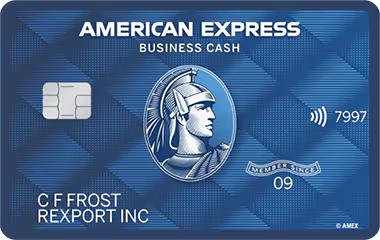
The Amex Blue Business Cash Card and the Amex Blue Business Plus Card share nearly identical earn structures - both earn at 2% on the first $50,000 in eligible purchases per calendar year, then 1% - with no annual fee. As of October 2026, each card charges a 2.7% foreign transaction fee on purchases after conversion to U.S. dollars. The single material difference is the rewards currency: cash back vs. Membership Rewards points.
The difference on the card pages is the unit. Cash earns a percentage back. Plus earns Membership Rewards points.
What does each card publish?
| Feature | Blue Business Cash | Blue Business Plus |
|---|---|---|
| Annual fee | $0 | $0 |
| Earn rate | 2% (first $50k/yr), 1% after | 2x MR pts (first $50k/yr), 1x after |
| Rewards type | Statement credit (auto-applied) | Transferable Membership Rewards points |
| Transfer partners | None | 20+ airline and hotel programs |
| Network | American Express | American Express |
| Foreign transaction fee | 2.7% | 2.7% |
| Expanded Buying Power | Yes | Yes |
| Term | Blue Business Cash | Blue Business Plus |
|---|---|---|
| Annual fee | $0 | $0 |
| Employee card fee | $0 | $0 |
| Foreign transaction fee | 2.7% after conversion to U.S. dollars | 2.7% after conversion to U.S. dollars |
| Elevated earn | 2% cash back | 2 Membership Rewards points per dollar |
| Elevated cap | First $50,000 of eligible purchases per calendar year | First $50,000 of eligible purchases per calendar year |
| Rate after the cap | 1% | 1 point per dollar |
| How the reward is delivered | Statement credit | Points that stay in the Membership Rewards account |
The fee block on the Cash page states the $0 annual fee and the 2.7% foreign transaction fee in the card’s rate data. The Plus fee block on that same data set states the same two fees. The $50,000 cap is in the earn section of each card page.
Cash credits the 2% to the statement. Plus does not convert the 2 points to a statement credit by itself.
How each card is structured
Both cards are revolving business credit cards issued by American Express. They are not charge cards. A revolving balance can carry past the due date and accrue interest at the APR on the cardholder agreement.
Cash is a cash-back card. The reward is a credit on the statement. There is no points balance and no transfer step.
Plus is a Membership Rewards card. Points accumulate in the Membership Rewards account tied to the card. American Express states that purchases on AmexTravel.com earn 2 points per dollar and do not count toward the $50,000 cap. Other eligible purchases do count toward the cap.
The two cards share a fee schedule and a cap. They do not share a rewards currency.
Fees and pricing mechanics
The annual fee is $0 on both cards, including the employee-card fee in the rate data. The foreign transaction fee is 2.7% of each transaction after conversion to U.S. dollars. A $1,000 purchase that converts to U.S. dollars produces a $27 fee before any reward. Both cards earn at the elevated rate only up to $50,000 in eligible purchases per calendar year. After that threshold, both drop to 1%/1x. Eligible purchases on AmexTravel.com with the Blue Business Plus also earn 2x points and do not count toward that card’s $50,000 cap. Businesses spending more than $50,000 annually on a single card should consider:
On the first $50,000, Cash returns 2% and Plus returns 2 points per dollar. After that threshold, both drop to 1% or 1 point. A business that puts $80,000 of eligible spend on Cash in one calendar year earns 2% on $50,000 and 1% on the remaining $30,000.
Interest, late fees, and returned-payment fees follow the agreement. The rate data lists a late fee of up to $39. Those fees are separate from the annual fee.
The price of holding either card is the foreign transaction fee on non-dollar purchases, plus interest if a balance revolves. The annual fee line is $0.
Limits, eligibility, and availability
The elevated rate stops at $50,000 of eligible purchases per calendar year on each card. The cap is per card, not a combined cap across Cash and Plus. The pages do not say the two caps merge when both cards are open.
AmexTravel.com spend on Plus is outside that card’s cap and still earns 2 points. The Cash page does not publish an equivalent exclusion for a travel-portal purchase.
Expanded Buying Power, on both pages, allows a purchase above the stated credit limit on a given charge. The amount above the limit is not a fixed number. American Express says it changes with use, payment history, and other factors, and that the over-limit amount is not unlimited. The over-limit portion is still a charge on the account.
The cards are U.S. business cards. The application asks for business information and a personal guarantee is part of American Express business-card underwriting. The pages do not state a public revenue minimum.
The cap and the foreign fee are published limits. The credit limit itself is assigned on the account.
Tradeoffs and constraints
A dollar of eligible spend under the cap produces $0.02 on Cash and 2 Membership Rewards points on Plus. Those are different units. A point is not a published cash price on the Plus page. Any later conversion of points to a statement credit, a travel booking, or a transfer partner is a separate Membership Rewards rule, not the earn rate.
The 2.7% foreign fee is larger than the 2% or 2-point earn rate. A foreign purchase on either card costs more in the fee than it returns in the elevated reward, before any other conversion of points.
Two cards double the $50,000 window only if both accounts are open and spend is split. The pages do not discount the second annual fee, because both annual fees are already $0. They also do not combine the foreign fee.
The cards match on fees and on the cap. They diverge on whether the reward is cash on the statement or points in Membership Rewards.
See also 2% business cards and the Amex Business Gold card.