

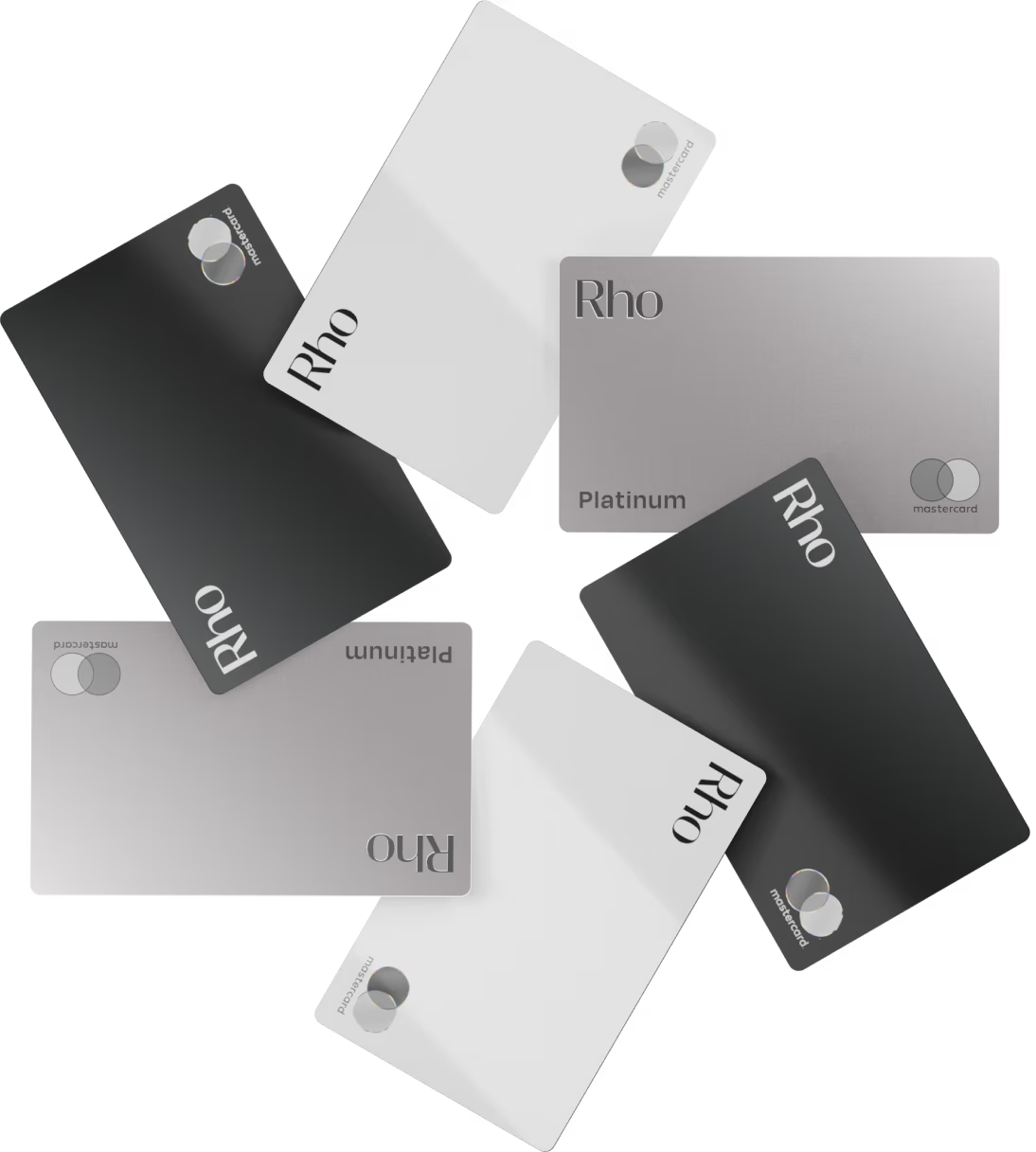
Rho is a financial technology company that issues a corporate charge card alongside business banking and spend-management tools. The card is built for companies that already route recurring payments through a single platform rather than across scattered vendor accounts. This review covers how the card is structured, how it is priced, who can open an account, and where the model creates constraints.
What the Rho card is structurally
The Rho card is a charge card issued against a company’s cash balance rather than a revolving credit line. It runs on the Mastercard World Elite Business network, which layers Mastercard Easy Savings merchant discounts on top of the card’s own cashback program. Rho pairs the card with business checking and bill-pay features inside one dashboard, so card transactions and bank balances appear in the same interface.
Because the card draws against verified cash rather than a separate credit facility, a company’s card limit typically moves with its account balance and spending history. Rho is a technology provider, not a bank; deposit and card-issuing functions are typically handled through a partner bank, as is standard for this category of fintech product.
Rho also offers physical and virtual card formats under the same account. A virtual card can typically be issued to an employee immediately after approval, while a physical card ships separately. Both card types draw from the same underlying cash balance and are subject to the same spending controls set by an administrator.
How the card is used in practice
Administrators issue virtual and physical cards to employees from a central dashboard. Each card can carry its own spending limit and merchant-category restriction, and administrators can adjust those limits after a card is issued. Transactions post to the same dashboard used for bill pay, so a finance team can view card spend and ACH or wire payments in one place.
Because the card is a charge card, the outstanding balance is due in full at the end of each billing cycle rather than carried forward. Bill-pay and card issuance share the same approval workflow, which routes an invoice or a card request through the same reviewers.
A single company account can typically support multiple cardholders, each with separately configured limits and category restrictions. When a limit or restriction is changed by an administrator, it applies to that employee’s card going forward rather than retroactively to prior transactions. This structure lets a finance team separate travel spend, software subscriptions, and vendor payments into distinct, individually tracked cards without opening separate bank accounts for each category.
Fees and pricing mechanics
Rho does not charge a monthly or annual fee for the corporate card itself. Rho’s revenue on the card comes primarily from interchange, the fee merchants pay card networks on each transaction, rather than from a subscription charge to the cardholder.
Cashback is tiered rather than flat, reaching up to 2% depending on the business’s account tier and payment frequency. The applicable tier is a function of spending volume, not a flat rate available to every account regardless of size. Cashback is typically credited as a statement credit rather than accumulated as points. Because the card runs on Mastercard World Elite Business, Mastercard Easy Savings discounts on business services apply independently of the cashback tier a business has reached.
Limits, eligibility, and availability
Rho’s corporate card program is available to U.S.-registered business entities, such as LLCs and corporations. The card and its spending limits are underwritten from the business’s own financial data and verified spending volume rather than from a founder’s personal credit history or a personal guarantee.
This underwriting approach ties both the card limit and the cashback tier to how much recurring transaction activity a company can demonstrate. As a result, the product is positioned toward companies with established, recurring payment activity rather than toward pre-revenue or early-stage businesses with limited transaction history. Rho’s card and banking products currently operate only within the United States.
Tradeoffs and limitations
The charge-card structure requires paying the full balance each cycle, so it does not provide the flexibility of a revolving credit line. A business that needs to carry a balance across multiple billing cycles would need a separate credit facility, since Rho’s standard card does not offer that option.
Tying the cashback tier to spending volume means a lower-volume account may not reach the top tier, so the effective cashback rate can be lower than the headline 2% figure for smaller accounts. A business would need to compare its expected monthly volume against the tier thresholds to know which rate actually applies to its spend.
Because the card and banking platform are integrated, a company’s card usage depends on the availability of Rho’s own technology layer rather than a separate card-only vendor. As with any fintech platform that layers services on top of a partner bank, the card-issuing and dashboard functions are a separate operational layer from the underlying deposit relationship.
The card’s underwriting model also means a company’s limit can move if its spending volume or cash balance changes. A business with seasonal or declining transaction activity may see its card limit or cashback tier adjust alongside that history, since the limit is not fixed independently of ongoing account activity. This differs from a fixed-limit credit product, where the limit typically does not change unless the issuer conducts a separate credit review.
More detail on Rho’s card terms and current tier structure is available on Rho’s official site.
See also: Corporate Card Rewards: Comparing Points vs. Flat Cashback, Ramp Corporate Card Review