
The Vanguard Group is a U.S. investment advisor and brokerage firm known for its mutual ownership structure. Unlike most financial institutions, which are owned by private shareholders or public stockholders, Vanguard is owned by its member funds. These funds, in turn, are owned by the investors who buy them.
This mechanical alignment of incentives is designed to keep management fees low, as the “profits” are effectively returned to investors in the form of reduced expense ratios.
At a glance
- Structure: Client-owned mutual fund company and broker-dealer.
- Minimum Investment: $0 for brokerage accounts; $1,000 to $3,000 for most mutual funds.
- Stock/ETF Trades: $0 commission (online).
- Key Feature: Automatic cash sweep to high-yield money market fund.
- Philosophy: Long-term, passive index investing.
The Mutual Ownership mechanism
Vanguard’s primary differentiator is its corporate architecture. Traditional brokers (like Schwab) must balance the interests of their brokerage customers with the profit expectations of their public shareholders.
Vanguard’s structure eliminates this conflict:
- Fund Ownership: The Vanguard mutual funds own the Vanguard management company.
- Investor Ownership: Investors who hold Vanguard mutual funds own the funds.
- Cost Alignment: Because the owners and the customers are the same group, Vanguard is incentivized to lower the cost of its funds over time. This has historically driven the industry-wide move toward low-cost index investing.
Mutual Funds vs. ETFs at Vanguard
While Vanguard supports trading in stocks and third-party ETFs, its core products are its proprietary mutual funds and ETFs.
Fractional Share Mechanics
Vanguard supports fractional shares primarily for its own products.
- Vanguard Funds: Investors can buy fractional shares of Vanguard ETFs and mutual funds.
- Third-party Equities: Fractional share trading for stocks and non-Vanguard ETFs is more limited compared to competitors like Robinhood or Fidelity.
Minimum Entry Hurdles
One mechanical friction point for new investors is the minimum investment requirement:
- Index Mutual Funds: Most “Admiral Share” index funds (e.g., VTSAX) require a $3,000 minimum initial investment.
- ETFs: Vanguard ETFs (e.g., VTI) can be purchased for the price of a single share, and fractional shares are supported, making them more accessible for small accounts.
Cash Sweep and Yield Mechanics
Vanguard handles uninvested cash (idle capital) with a high degree of transparency compared to its peers.
- Automatic Sweep: All idle cash in a Vanguard Brokerage Account is automatically “swept” into the Vanguard Federal Money Market Fund (VMFXX).
- Yield Profile: VMFXX typically offers a yield that is significantly higher than the standard “sweep” rates at traditional brokers (which often pay 0.01% to 0.45% on base savings).
- Liquidity: The sweep is automated; when an investor places a trade, the system automatically liquidates the necessary amount of the money market fund to cover the purchase.
The User Interface and Experience
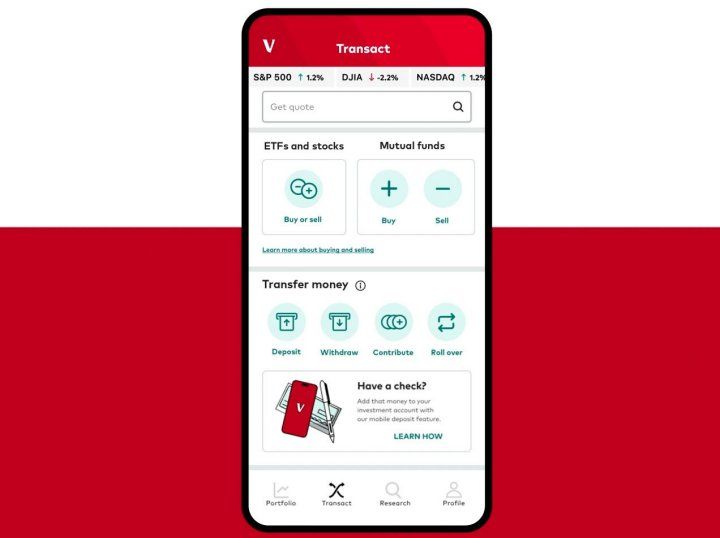
Vanguard’s platform is functionally designed for stability and long-term planning rather than active, high-frequency trading.
- Interface Logic: The web and mobile interfaces prioritize “Total Portfolio Value” and asset allocation views.
- Trading Tools: Vanguard lacks the advanced charting and professional-grade desktop platforms (like Schwab’s thinkorswim) found at active-trading brokers.
- Speed of Innovation: The system is often described as “functional” but “dated.” New features (like real-time data updates) are rolled out more conservatively than at mobile-first neobrokers.
Eligibility and Account Protections
Vanguard is a U.S. broker-dealer and a member of SIPC.
- SIPC Coverage: Securities are protected up to $500,000 (including $250,000 for cash) in the event of broker failure.
- Vanguard’s Additional Coverage: Vanguard maintains an aggregate policy through syndicates at Lloyd’s of London for additional protection for client assets.
- Self-Employment Focus: Vanguard is a major provider of i401(k) (Solo 401k) and SEP IRA accounts for small business owners and freelancers.
See also: Fidelity Review, Vanguard vs. Fidelity Comparison, Best Stock Brokers for Beginners