

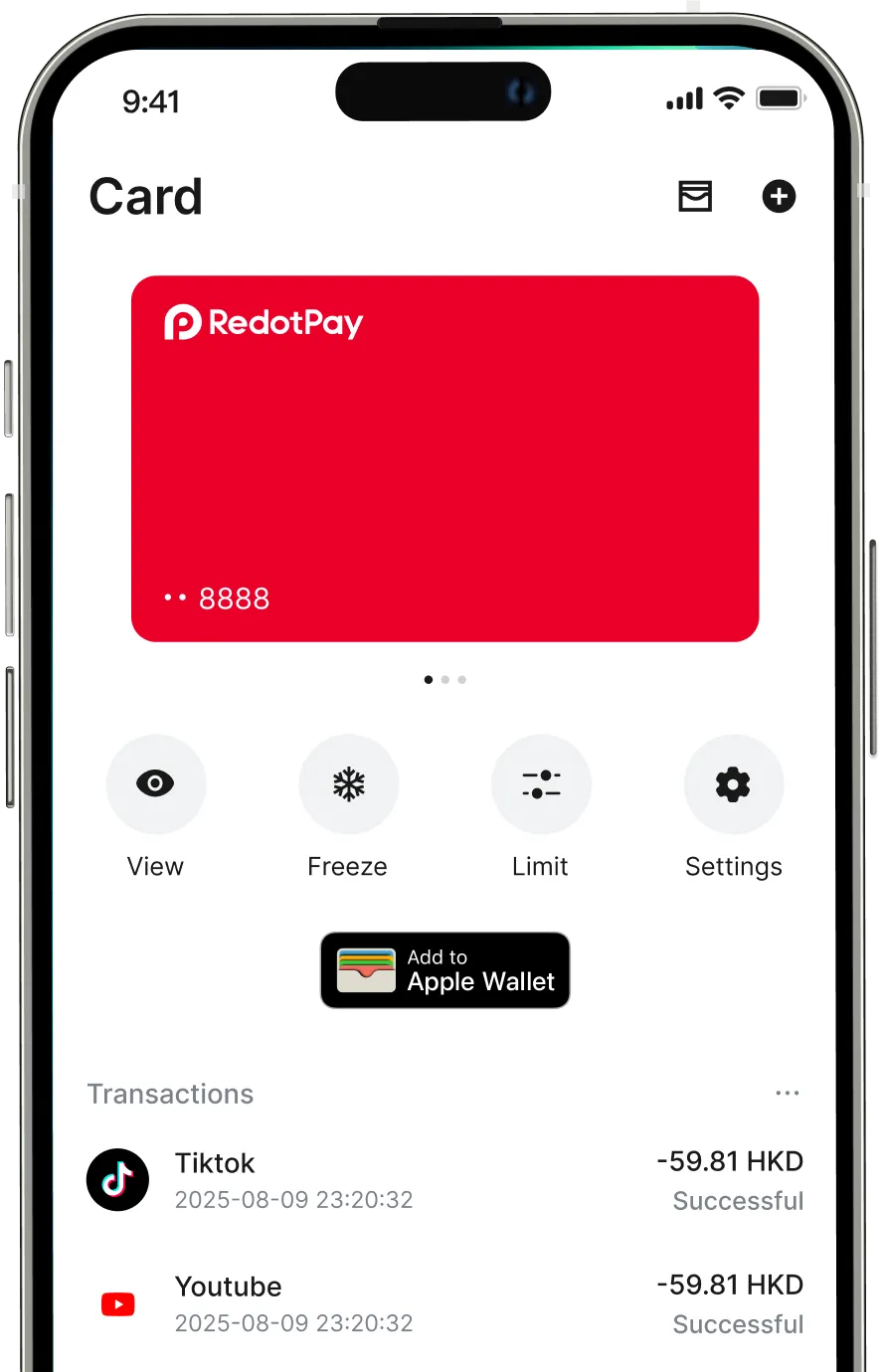
RedotPay is a custodial cryptocurrency payment platform that provides virtual and physical cards. The platform lets a crypto balance pay merchants that accept the card network, online and in store. Help-center articles dated July 24 and July 27, 2026 are the fee source for this review.
On October 2, 2026, the official RedotPay account stated that the service had passed 9 million users, 100 countries, and $14 billion in annualized payment volume. That post is a company statement, not a filing. The same account later described PIX QR payments in Brazil, SPEI deposits in Mexico, and Bre-B QR payments in Colombia.
What the RedotPay Card is structurally
Structurally, RedotPay is a custodial prepaid card system. Unlike a self-custodial wallet, RedotPay holds assets in its app environment. When a user deposits Bitcoin, Ethereum, or stablecoins such as USDC and USDT, the platform records the balance on its internal ledger.
The card is issued through a partner and links to that unified balance. There is no separate offline card purse. Authorization draws on the custodial balance at the moment of payment.
How it works in practice
The core mechanism is conversion at spend time. When a physical card or a virtual card in Apple Pay or Google Pay pays a merchant, the authorization engine checks the crypto balance. If the balance covers the purchase and the fees, the system converts cryptocurrency and settles fiat with the merchant.
The July 27, 2026 ATM article lists a 1% crypto conversion fee on card use. A transaction in the card’s own currency has no extra currency fee. A transaction in another currency adds 1.2%.
Users can choose which assets are spent first. Peer-to-peer transfers between RedotPay users run on the internal ledger. The help center also documents in-app security controls for online payments, in-store payments, ATM use, and the currencies a card will accept.
Fees and pricing mechanics
RedotPay uses issuance fees and transaction fees rather than a required monthly membership.
- Issuance fees: As of the July 27, 2026 card article, a virtual card costs 10 USD and a physical card costs 100 USD. The fee is taken from the balance when the card is issued. A 5 USD welcome reward cannot pay the issuance fee.
- Conversion: The ATM fee article lists crypto conversion at 1%.
- Other currencies: Spend in a currency other than the card currency adds 1.2%. Spend in the card currency does not add that fee.
- ATM withdrawal: A physical card can withdraw at ATMs on major networks. An HKD card is listed at 2%. A USD card is listed at 2% up to 10,000 USD a month and 3% on the amount above that. The ATM operator can add its own surcharge.
- No required monthly fee on the base card: Optional RedotPay Pro is a separate subscription.
Pro has two prices on its getting-started article: 12.90 USD a month, or 129 USD a year. The monthly plan waives the 10 USD virtual-card fee once and pays 3% cashback on Apple Pay and Google Pay purchases, up to 18 USD a month. The annual plan adds a one-time waiver of the 100 USD physical-card fee, the same 3% wallet cashback cap, an extra 1% APY on RedotPay Earn, and a waiver of RedotPay’s own ATM fees on up to 1,000 USD of withdrawals a month. Operator ATM fees are outside that waiver.
A change to the phone number, email, authenticator, or password temporarily cuts card limits to 1,000 USD per transaction and 1,000 USD per day for 24 hours. That security cap is documented in a July 14, 2026 help article.
Limits, eligibility, and availability
The help center does not publish a one-million-dollar daily spend ceiling. Cardholders set per-purchase and daily limits in the app, separately for each card. The only hard temporary ceiling in the fetched articles is the 1,000 USD security-change cap.
- Spending limits: User-set per purchase and per day, restored to the usual limit 24 hours after a security-setting change.
- ATM: Physical cards only. The fee schedule above is the published ATM price, not a published monthly cash ceiling beyond the 10,000 USD point where the USD ATM rate steps from 2% to 3%.
- Eligibility: The app and the regional card flow decide where a physical card can ship. The July 2026 fee articles do not publish a country exclusion list.
- Verification: Higher use of the account still runs through KYC. The help center treats identity checks as part of card setup.
The October 2026 posts about PIX, SPEI, and Bre-B are product announcements from the official account. They are local pay-in or QR flows, not a change to the card issuance prices above.
Tradeoffs, risks, or limitations
The primary tradeoff is custodial risk. Because RedotPay holds the assets, access depends on platform security and solvency. A technical or regulatory freeze can block the balance, which is the constraint described in custodial wallet mechanics.
Base cards do not publish a broad cashback rate. The 3% figure is limited to Apple Pay and Google Pay spend on Pro, and it stops at 18 USD a month. A 1% conversion fee plus 1.2% on a foreign-currency purchase is the stacked cost on a small international payment, before any ATM operator fee.
Understanding those card mechanics is what makes the issuance price and the Pro cap comparable to other stablecoin cards. Stablecoin balances are also not the same as insured cash, as covered in why stablecoins are not risk-free cash.