
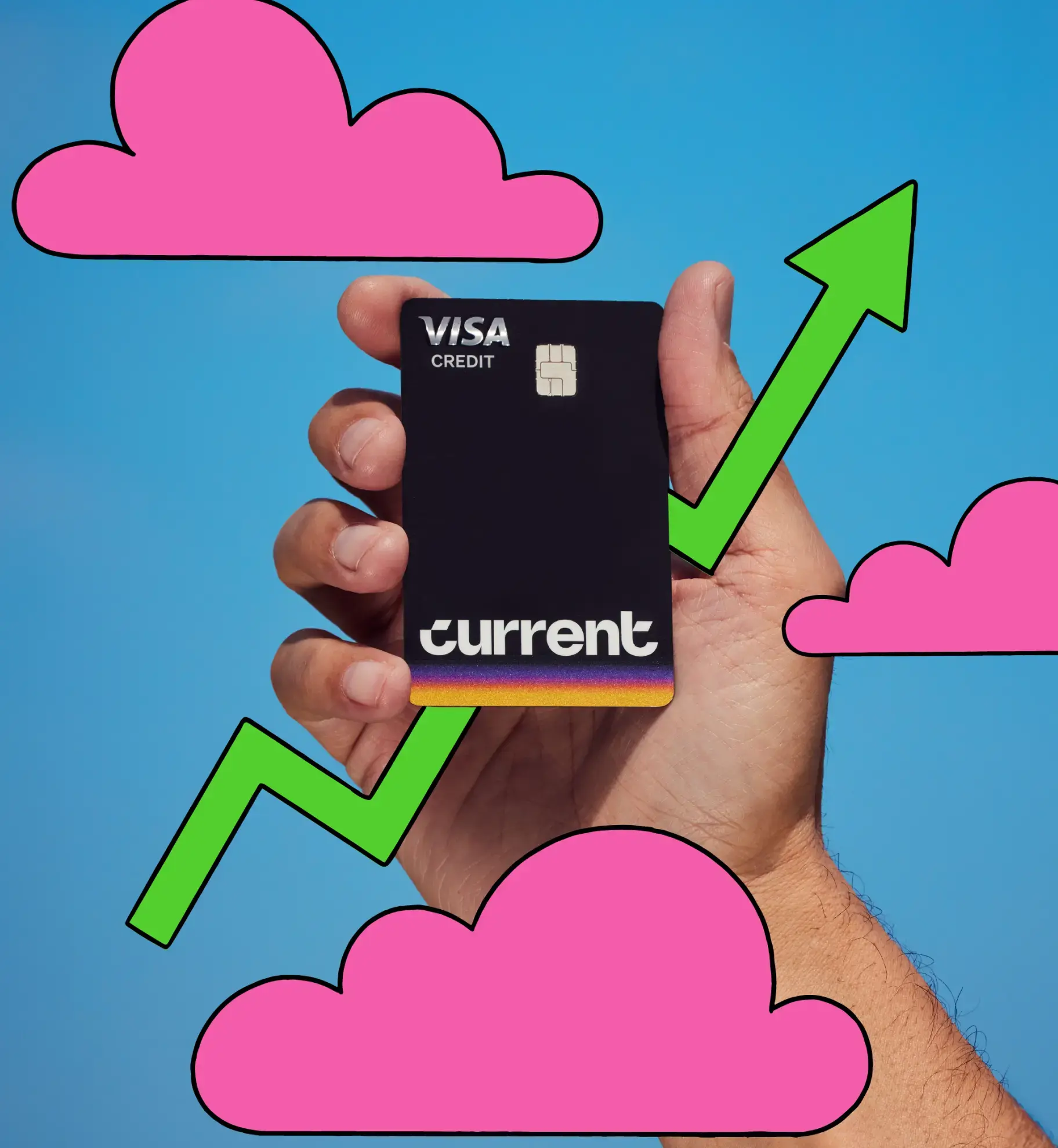
Current is a financial technology company that provides mobile banking services through partnerships with FDIC-insured banks. The platform focuses on high-yield savings tools, teen banking features, and credit-building products managed entirely through a mobile interface. By eliminating the infrastructure costs associated with physical branches, Current offers features comparable to other leading neobanks.
This structure allows for a multi-product ecosystem where users can access fee-free overdraft and accelerated access to direct deposits. Like other digital platforms, it relies on partner banks for core depository functions.
At a glance
- Structure: Financial technology company partnering with Choice Financial Group and Cross River Bank.
- FDIC Insurance: Deposits insured up to $250,000 per depositor through partner banks.
- Primary Products: Individual and teen checking accounts, plus Savings Pods.
- Key Features: Overdrive (fee-free overdraft), Current Pay (cash advances), and the Build secured credit card.
- Constraints: No physical branches, 3% foreign transaction fees, and balance caps on peak savings rates.
How does Current operate as a financial platform?
Current does not hold its own bank charter; instead, it operates as the technology and customer service layer for regulated banking institutions. As of 2026, Current partners primarily with Choice Financial Group and Cross River Bank, N.A. to provide the underlying financial infrastructure. This “banking-as-a-service” (BaaS) model allows Current to focus on mobile app design and specific product features like teen banking while shifting the regulatory and depository responsibilities to established banks.
For users, this means that while the Current app is the interface for all transactions, the legal custody of funds remains with the partner banks. This structure is common in the U.S. fintech industry, providing a bridge between modern user experience and traditional regulatory safety. Users are subject to the policies of both Current and its depository partners, which are subject to oversight by federal regulators.
How are checking accounts and Savings Pods structured?
The platform uses a modular approach to account management, allowing users to separate their funds into different buckets based on their financial goals.
Checking Account
The primary checking account includes a Visa debit card and functions without monthly maintenance fees or minimum balance requirements. Deposits are accepted via direct deposit, mobile check deposit, or cash at participating retail locations. Current provides fee-free access to approximately 40,000 Allpoint ATMs. Out-of-network withdrawals typically incur a $2.50 fee from Current, plus any charges from the ATM operator.
How Savings Pods work
Current organizes savings into “Savings Pods” rather than a traditional savings account. Each pod acts as a separate sub-balance that can be labeled for a specific goal, such as an emergency fund or a vacation. Interest rates are tiered based on the user’s direct deposit activity.
| Direct Deposit Status | Annual Percentage Yield (APY) | Maximum Balance per Pod |
|---|---|---|
| $200+ monthly direct deposit | 4.00% APY | $2,000 ($6,000 total across 3 pods) |
| No qualifying deposit | 0.25% APY | Same limits apply |
The 4.00% APY is intended to serve as a high-yield incentive for active depositors, though the $2,000-per-pod cap limits the feature’s utility for users with larger balances. Funds in pods remain liquid and can be moved back to the main checking balance instantly.
How does the Overdrive fee-free overdraft system work?
Overdrive is Current’s fee-free overdraft feature, designed to allow eligible accounts to process transactions even when their balance reaches zero. This mechanism functions as a temporary safety net rather than an open-ended line of credit.
Eligibility and Limits
Access to Overdrive requires receiving at least $500 in qualifying direct deposits each month. Limits are dynamic and typically range from $25 to $200, adjusted automatically based on account history and deposit consistency. Current does not charge fees for using the feature, but transactions that exceed the user’s specific Overdrive limit are declined rather than processed.
Repayment and Coverage
Overdrive covers debit card purchases and ATM withdrawals. It does not apply to:
- ACH transfers (e.g., electronic bill payments)
- Check-based transactions
- Transfers to external accounts
Any negative balance created through Overdrive must be repaid within 60 days. Typically, the repayment occurs automatically when the next direct deposit or transfer arrives in the account. Failure to repay within the timeframe can result in the suspension of the feature or account restrictions.
What defines the Current Pay cash advance mechanism?
Current Pay is a separate liquidity feature that provides eligible users with cash advances based on their calculated future income. This differs from Overdrive in that it provides cash that can be used for any purpose, not just to cover card transactions.
Access Requirements
Access to Current Pay is not guaranteed and requires a history of consistent deposits. Standard requirements include:
- At least 60 days of account history
- At least three direct deposits within the last 60 days
- An average direct deposit amount of at least $300
The Advance Mechanism
Eligible users can request advances between $50 and $750. The platform evaluates the user’s risk profile to determine the specific limit. Repayment is structured to occur automatically from the user’s next incoming direct deposit. While Current often advertises “no interest” for these advances, certain usage fees or optional “tips” may apply depending on the speed of the transfer or the specific terms offered at the time of the request.
How do teen banking features provide supervised access?
One of Current’s primary differentiators is its dedicated teen banking ecosystem, which allows parents to provide their children with a supervised financial experience.
Parental Oversight and Controls
Teen accounts are linked to a parent’s Current account, allowing for real-time monitoring and control. Parents can:
- Transfer allowance money instantly
- Set spending limits and block specific merchant categories
- Receive notifications for every transaction made by the teen
- Assign chores and automate allowance payments
The Teen Experience
Teens receive their own debit card and a simplified version of the Current app. This allows them to manage their own “Savings Pods” and track their spending, fostering financial literacy in a controlled environment. Unlike traditional joint bank accounts, Current’s teen accounts provide more granular controls and a mobile-first experience adapted for younger users.
Why does the Build card use a secured spending model?
The Build Card is a secured credit card designed for users looking to establish or improve their credit scores without the risk of high-interest debt or traditional credit checks.
The Secured spending logic
The Build Card does not offer a traditional credit limit. Instead, the user must move funds from their Current checking account into a dedicated “Build” account. This balance becomes their spending limit. When the card is used, the funds are already held to cover the bill, ensuring the balance can be paid in full at the end of the month.
Impact on Credit Reporting
Current reports the card’s usage and payment history to major credit bureaus. Because the system is automated to ensure on-time payments, it helps users build a positive payment history. However, credit score changes are not guaranteed and depend on the user’s overall credit profile and broader financial behavior. No annual fees apply to the card, which distinguishes it from many traditional secured cards.
How does the early direct deposit feature work?
Current offers a feature where direct deposits can be credited to an account up to two days before the scheduled payday. This is made possible by the way the Automated Clearing House (ACH) network processes payroll.
The Crediting Mechanism
When an employer’s payroll provider initiates a transfer, a notification is sent to the financial network several days before the funds are officially settled. Current’s partner banks receive this notification and, under Current’s policy, they credit the user’s account immediately rather than waiting for the settlement date.
Factors Affecting Timing
The arrival of funds depends entirely on when the employer submits the payroll file. If the file is submitted late, the funds will not arrive early. Government payments and one-time transfers from other banks may also follow different processing schedules and may not always qualify for early availability.
What are the operational tradeoffs and costs?
While Current provides high-yield savings and unique family tools, it involves certain tradeoffs characteristic of digital-only platforms.
Physical and Service Constraints
Current has no physical branches. This means users cannot access:
- In-person notary or cashier’s check services
- Face-to-face assistance for complex disputes
- Cash deposits without visiting a third-party retailer and paying a fee (typically $3.50)
Fee Mechanics
While many features are free, Current charges a 3% fee for foreign transactions, which can be expensive for international travelers or users making overseas purchases. Additionally, while standard bank transfers are free, instant transfers to external debit cards incur fees which vary by transaction size.
How is FDIC insurance provided for Current depositors?
As a fintech, Current relies on federal deposit insurance Provided through its partner institutions to protect customer funds.
FDIC Coverage
Deposits are held at Choice Financial Group or Cross River Bank, N.A. These institutions are members of the Federal Deposit Insurance Corporation (FDIC), meaning that each depositor’s funds are insured up to $250,000. This insurance protects users in the event that the partner bank fails. It is important to note that FDIC insurance typically does not cover funds while they are in transit or held at non-bank entities.
Consumer Protections
Transactions on the Current platform are protected by Regulation E, which governs electronic fund transfers. Users are protected against unauthorized charges if they report the error within 60 days. The Current Visa debit card also includes standard Visa fraud protection and “Zero Liability” policies for unauthorized use.
Common questions about Current’s digital banking app
Is Current a real bank?
Current is a financial technology company, not a bank. The banking services are provided by its partner banks, Choice Financial Group and Cross River Bank, N.A., which are FDIC members.
Can I have a teen account without an adult account?
No, Current teen accounts must be sponsored and managed by an adult who has an active Current account. This ensures that a parent or guardian can supervise and fund the teen’s account.
How do I deposit cash?
Cash can be deposited at over 90,000 participating retail locations, including 7-Eleven, CVS, and Dollar General. Most retailers charge a $3.50 fee for this service.
Why certain misconceptions about Current’s features persist
Misconception: “Current Pay is a payday loan”
Current Pay provides an advance against future deposits, but unlike a payday loan, it generally does not charge traditional interest rates or require a credit check. It is a service based on deposit history and is intended for short-term liquidity.
Misconception: “The 4% APY applies to all my money”
The 4.00% APY is only available to users with qualifying direct deposits and is capped at $2,000 per Savings Pod, for a total of $6,000. Balances above this limit earn a significantly lower base rate (typically 0.25%).
Misconception: “Current is free for everyone”
While there are no monthly fees for basic accounts, users can still incur costs through ATM fees, cash deposit fees, and foreign transaction fees. The “free” nature of the account depends on the user’s specific banking habits.