
Conkarta is a financial technology platform that facilitates the issuance of U.S. dollar charge cards to high-net-worth individuals who do not reside in the United States. The system is designed specifically for globally mobile professionals and investors who maintain significant assets in U.S. financial institutions but lack a U.S. Social Security Number (SSN). It is a different product from Karta.io, the Visa Signature crypto card.
This review documents the structural mechanics, asset-backed approval process, and operational trade-offs of the Conkarta card system. Figures are taken from Karta’s site and the account-opening disclosure as of October 2026.
What Conkarta is structurally
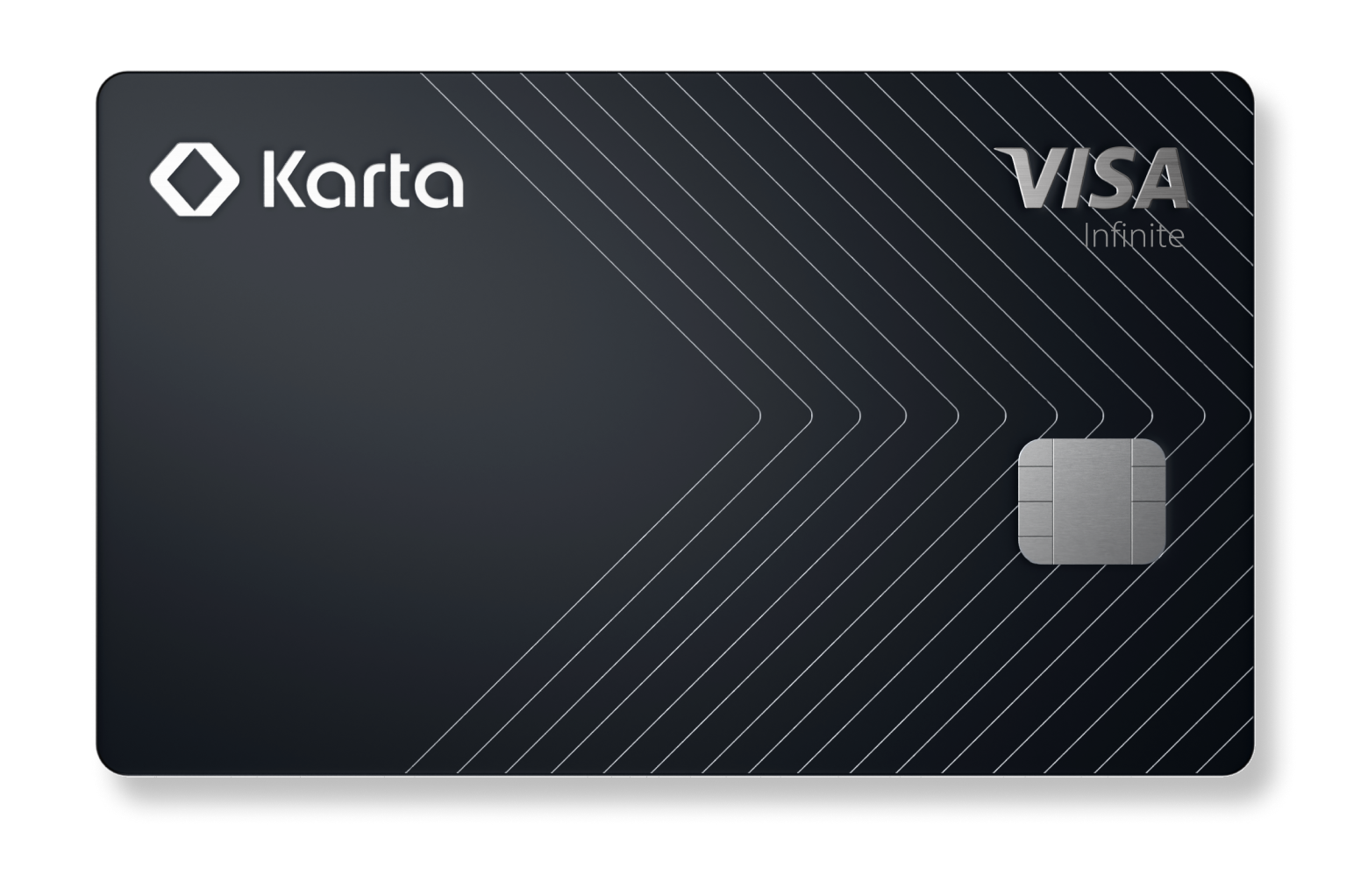
Conkarta (often marketed as Karta) is a premium charge card program issued in the United States on the Visa Infinite network. Unlike traditional credit cards that rely on personal credit scores and history with U.S. credit bureaus, Conkarta utilizes an “Assets Under Management” (AUM) model for underwriting and approval.
Structurally, the product is a charge card rather than a revolving credit card. Interactive Brokers describes its co-branded version as the Karta Visa Infinite Charge Card, with the balance paid through the linked brokerage account. The card is typically issued through partnerships with U.S. banks, with Conkarta providing the technology layer for asset verification, customer support, and digital management.
The platform targets individuals who have established brokerage accounts or bank balances with U.S. institutions such as Interactive Brokers or Charles Schwab. By linking these accounts, the system can verify the user’s liquidity and net worth, allowing for a U.S.-issued card without local residency or a domestic credit file. The public site states that an SSN is not required.
How the system works in practice
The application process for a Conkarta card is centered on digital asset verification rather than traditional paperwork. Prospective users must link their U.S. financial accounts, allowing Conkarta to view current balances and asset data.
Once an account is approved, the user receives access to a virtual card, which can be added to mobile wallets like Apple Pay or Google Pay. A physical metal card is subsequently issued and shipped to the user’s international address. The management of the card, including spending tracking, limit adjustments, and customer service, is primarily handled through a digital interface and a dedicated WhatsApp concierge.
The concierge service is a core feature of the practice, providing 24/7 support for travel bookings, restaurant reservations, and administrative tasks. This service mirrors the high-touch support models found in traditional private banking and ultra-premium credit products.
Fees and pricing mechanics
The Conkarta system involves several distinct cost components. The account-opening disclosure is the price list used here.
- Annual Fee: The disclosure lists a $300 annual fee. The same $300 figure appears on the public site and on the Interactive Brokers partner page.
- Additional cards: The disclosure lists $150 for an additional metal card and $0 for a companion plastic card.
- Foreign exchange: The disclosure lists an international transaction fee of 0% of each transaction in U.S. dollars. A Brazil-specific page markets a separate Pix path at 0% IOF and a 0.69% spread. That spread is a local funding price, not the international-transaction line.
- Asset maintenance: The main site says a minimum of $100,000 must be held at a U.S. financial institution. The Interactive Brokers path uses a lower test: $50,000 in assets and $25,000 withdrawable, for citizens on IBKR’s published list, which includes the United States.
The pricing structure is built around users who already keep a large USD balance at a supported institution. Cash advances and balance transfers are marked N/A on the disclosure table.
Limits, eligibility, and availability
The public site markets credit lines up to $200,000, based on U.S. assets. The disclosure says the limit is set in part from assets under management with the user’s bank and the partner bank. It also says a daily or monthly spending limit can be applied even when assets cover the purchase, and that the limit can be temporary or permanent.
Eligibility Requirements:
- Non-Resident Status: The main site is written for applicants without an SSN. The IBKR citizenship list also includes the United States, so that partner path is not limited to non-residents.
- Minimum assets: $100,000 on the main site. $50,000 in assets and $25,000 withdrawable on the IBKR page.
- Identity Verification: Users must provide a valid international passport and undergo standard Anti-Money Laundering (AML) checks.
The card is offered where the partner program and sanctions screening allow it. A single percentage of AUM is not printed as the limit formula on the pages reviewed in October 2026. The marketed ceiling is $200,000.
Trade-offs, risks, and limitations
The primary trade-off of the Conkarta system is the exchange of a linked U.S. asset balance and a $300 annual fee for a U.S. Visa Infinite charge card.
Pros and Efficiency:
- No SSN Required: The main site states that a U.S. Visa Infinite card is available without a Social Security Number.
- Global Utility: As a U.S.-issued Visa, the card is marketed for acceptance on the Visa network, including Priority Pass Select on the public site.
- Asset-based limits: The published ceiling is $200,000, tied to assets rather than to a consumer credit score.
Risks and Constraints:
- Data access: Users grant the program a view of linked brokerage or bank balances. That adds a party to the account’s data path.
- Charge card, not a revolving balance: IBKR and the Karta site describe a charge card paid through the linked account. The disclosure allows the partner agreement to cover how a shortfall is collected.
- Two asset floors: $100,000 on the main site and $50,000 on the IBKR page. The pages do not collapse to one number.
- Name collision: Karta.io uses the short name Karta and publishes a different fee table, in USDT, for a Visa Signature crypto card.
Credit-bureau reporting is not stated in the disclosure pages reviewed for this update. Whether charges appear on a U.S. credit file is outside those pages.
See also: Amex Platinum Card Review, Private Banking Differences, How Credit Scores Work