
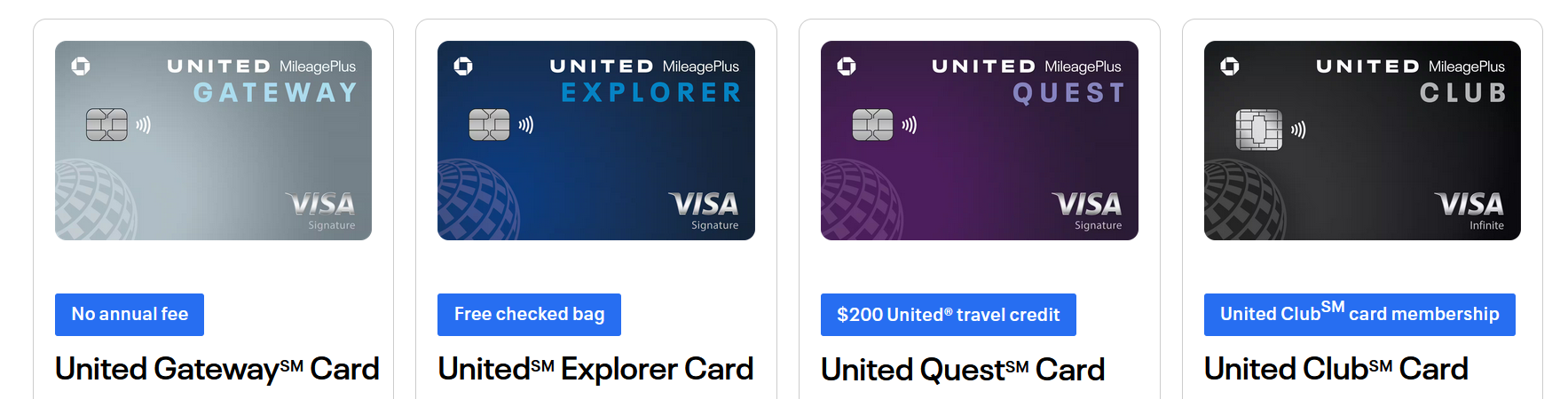
Chase issues four consumer United Airlines credit cards in the United States. They are the United Gateway Card, the United Explorer Card, the United Quest Card, and the United Club Infinite Card.
The cards post MileagePlus miles on purchases. Three of them also post Premier Qualifying Points, or PQPs, toward Premier status. Chase states that the pricing information below was accurate as of 22 September 2026.
How do the annual fee and reward structures compare?
Chase lists a separate annual fee and a separate United purchase rate on each card.
| Card | Annual fee | United purchases | Other listed bonus rates |
|---|---|---|---|
| Gateway | $0 | 2x | 2x gas stations and local transit |
| Explorer | $0 in year one, then $150 | 3x | 2x dining and hotels booked with the hotel |
| Quest | $350 | 4x | 2x other travel, dining, and select streaming. 5x on prepaid Renowned Hotels stays |
| Club Infinite | $695 | 5x | 2x other travel and dining. 5x on prepaid Renowned Hotels stays |
Chase also states a combined total on eligible United flights. That total adds miles United credits on the primary cardmember’s fare to the card miles above.
Gateway’s combined total is 5x before $10,000 in calendar-year purchases and 8x after that spend. Explorer is 9x. Quest is 10x. Club Infinite is 11x.
Mileage earning differs for Basic Economy or base fares. Premier members earn more on the United fare portion.
Other United purchases at the card rate include seat upgrades, Economy Plus, inflight food, beverages, Wi-Fi, and baggage fees. Chase excludes United Cruises, MileagePlus X, and some other United products from that bonus.
Fee and Cost Structures
The annual fee is the recurring charge. Interest applies only when a balance remains after the grace period.
Annual fee on each card
- Gateway. Chase pricing and terms list no annual membership fee.
- Explorer. Chase pricing and terms list a $0 introductory fee for the first year, then $150.
- Quest. Chase pricing and terms list a $350 annual membership fee.
- Club Infinite. Chase pricing and terms list a $695 annual membership fee.
Interest and other account fees
The purchase APR on Explorer, Quest, and Club Infinite is 19.99% to 28.49% variable. Gateway has a 0% introductory purchase APR for the first 12 months, then the same 19.99% to 28.49% range.
Chase ties those rates to the Prime Rate. The pricing box uses a 7.00% Prime Rate as of 22 September 2026 and adds 12.99% to 21.49%. The stated maximum APR is 29.99%.
The due date is at least 21 days after the billing cycle closes. Chase does not charge interest on new purchases when the cardmember pays the entire balance, or the Interest Saving Balance, by the due date.
The penalty APR can go up to 29.99%. A late payment fee can go up to $40. Foreign transactions are $0 on all four cards. The Consumer Financial Protection Bureau publishes general factors for comparing card costs.
Who can open an account
Chase requires a valid permanent home address in the 50 states, the District of Columbia, Guam, Puerto Rico, or the U.S. Virgin Islands, or a U.S. military address. Applicants must be at least 18. The minimum age is 19 in Alabama and Nebraska, and 21 in Puerto Rico.
How does PQP earning vary across card tiers?
PQP from card spending is capped. The rate and the cap depend on the card. Gateway offer details do not list a PQP rate.
| Card | Spend rate | Spend cap | Card-bonus PQP |
|---|---|---|---|
| Gateway | Not listed | Not listed | Not listed |
| Explorer | 1 PQP per $20 | 1,000 PQP per calendar year | Not listed |
| Quest | 1 PQP per $20 | 18,000 PQP per year | 1,000 PQP each year |
| Club Infinite | 1 PQP per $15 | 28,000 PQP per year | 1,500 PQP each year |
Explorer counts net purchases, including authorized-user purchases, and excludes cash-like transactions.
Quest and Club Infinite award the card-bonus PQP within 8 weeks of 1 February, starting in the calendar year after the account opens. Those bonus PQPs are separate from PQPs earned on spend.
What are the primary baggage and boarding benefits?
Bag waivers and boarding priority differ by card. Codeshare flights are excluded. Chase requires the MileagePlus number on the reservation.
Checked bags
The Gateway Card deposits two first-standard-bag certificates after $10,000 in calendar-year purchases, with a limit of two certificates a year. Chase requires the primary cardmember to buy the ticket with the card and apply the certificates at checkout.
The Explorer Card waives the first standard checked bag for the primary cardmember and one companion on the same reservation. The primary cardmember must buy the ticket with the Explorer Card. That purchase rule is waived for flights completed in the 90 days after account opening.
The Quest Card and the Club Infinite Card waive the first and second standard checked bags for the primary cardmember and one companion. The same card-purchase rule and 90-day waiver apply. Oversized, overweight, and extra-bag charges still apply on all four cards.
Boarding and airport priority
Explorer and Quest include Group 2 boarding for the primary cardmember and companions on the same reservation, on United-operated flights. Club Infinite includes Premier Access where available. That covers priority check-in, security screening, boarding, and baggage handling. Gateway offer details do not list priority boarding.
How do the lounge access and travel credits differ?
Explorer includes two United Club passes a year. Quest lists no lounge access. Club Infinite includes United Club membership for one adult guest.
United Club access
Explorer includes two United Club one-time passes a year. Quest offer details do not include United Club membership or passes. Club Infinite includes United Club membership for the primary cardmember. The membership allows one adult guest and dependent children under 18 on each visit. Chase states that Star Alliance lounge access is not included.
Club Infinite can add United Club All Access after Premier Gold status, or after more than $50,000 in net purchases in a calendar year. All Access then lasts for the rest of that calendar year and the following calendar year. Keeping it requires Premier Gold or the same spend rule again.
Gateway offer details do not list lounge access.
Award pricing and mile discounts
Cardmember award pricing applies to United and United Express awards booked with the primary cardmember’s MileagePlus account. It does not apply to Money + Miles tickets.
General members get at least 10% fewer miles than the base price paid by members without an eligible card. Premier members get at least 15% fewer miles than that same base price.
Gateway unlocks that pricing after $10,000 in calendar-year purchases. Explorer, Quest, and Club Infinite include it without that spend gate. The benefit can take up to 5 weeks after the card is issued.
A separate 10,000-mile award discount is tied to spend. Explorer and Quest each allow one discount after $20,000 in calendar-year purchases. Club Infinite allows one discount per $20,000, up to two discounts and $40,000 in net purchases.
Quest also lists a 10,000-mile award discount at the first anniversary and each anniversary after that.
Statement credits
All four cards return 25% as a statement credit on food, beverages, and Wi-Fi on United-operated flights, and on United Club premium drinks, when the card pays.
Explorer, Quest, and Club Infinite also list a statement credit of up to $120 every four years for a Global Entry, TSA PreCheck, or NEXUS application fee charged to the card. Rideshare credits require a yearly opt-in. Instacart credits end 31 December 2027.
| Credit | Gateway | Explorer | Quest | Club Infinite |
|---|---|---|---|---|
| United flight credit | None listed | $100 TravelBank cash after $10,000 in a calendar year | $200 TravelBank cash after opening and each anniversary | None listed |
| Prepaid hotel credit | None listed | Up to $100 a year at United Hotels, $50 on each of the first two stays | Up to $150 a year at Renowned Hotels and Resorts | Up to $200 a year at Renowned Hotels and Resorts |
| Rideshare | None listed | Up to $60 a calendar year, $5 a month | Up to $100 a calendar year, $8 a month from January through November and $12 in December | Up to $150 a calendar year, $12 a month from January through November and $18 in December |
| Avis or Budget, booked on United’s travel site | None listed | Up to $50 a year, $25 on each of the first two rentals | Up to $80 a year, $40 on each of the first two rentals | Up to $100 a year, $50 on each of the first two rentals |
| Instacart | None listed | Up to $120 a calendar year | Up to $180 a calendar year | Up to $240 a calendar year |
| JSX flights | None listed | Up to $100 a year | Up to $150 a year | Up to $200 a year |
Elite Status Shortcuts
Card PQP does not by itself assign a Premier level. It adds points toward the PQP requirement United sets for each level.
Gateway offer details do not list PQP. Explorer stops at 1,000 spend PQP in a calendar year and does not list a card-bonus PQP.
Quest can add 1,000 card-bonus PQP plus up to 18,000 spend PQP. Club Infinite can add 1,500 card-bonus PQP plus up to 28,000 spend PQP at 1 PQP per $15. The card-bonus PQP on Quest and Club Infinite begins the calendar year after account opening.
Quest also lists two global Economy Plus seat upgrades after $40,000 in calendar-year purchases. That upgrade is separate from PQP.
What limits each card?
Each card omits a benefit another card in the lineup includes.
The Gateway Card has no annual fee and no listed PQP. Bag certificates require $10,000 in calendar-year purchases. Award pricing has the same spend gate. The card does not list priority boarding or United Club access.
The Explorer Card’s fee is $150 after a $0 first year. The bag waiver covers one standard bag. Lounge access is two United Club one-time passes a year. Spend PQP stops at 1,000.
The Quest Card charges $350 and does not list United Club access. The anniversary 10,000-mile discount starts at the first anniversary. The 1,000 card-bonus PQP starts the following calendar year.
The Club Infinite Card charges $695. Standard membership allows one adult guest and dependent children under 18. Chase states that Star Alliance lounge access is not included. All Access depends on Premier Gold or on more than $50,000 in net purchases.
Explorer, Quest, and Club Infinite list primary auto rental coverage up to $60,000 for most vehicles with an MSRP of $125,000 or less. Chase requires the cardmember to decline the rental company’s collision insurance and charge the entire rental to the card. Gateway coverage is secondary to personal insurance in the United States.
Common Misconceptions
“The Gateway Card includes a free checked bag on every flight.” The Gateway Card adds two first-standard-bag certificates after $10,000 in calendar-year purchases. Without those certificates, the bag fee still applies.
“Every United card earns 1 PQP per $20.” Gateway offer details do not list PQP. Explorer and Quest use 1 PQP per $20, with caps of 1,000 and 18,000. Club Infinite uses 1 PQP per $15, up to 28,000 PQP a year.
“The Quest Card includes lounge access.” Quest offer details do not include United Club membership or passes. Explorer includes two one-time passes a year. Club Infinite includes membership.
“Club Infinite membership works in any Star Alliance lounge.” Chase states that Star Alliance lounge access is not included with United Club card membership.
“Miles from the card are a different currency from miles earned by flying.” Purchase miles post to the same MileagePlus account as the cardmember’s other MileagePlus miles.