
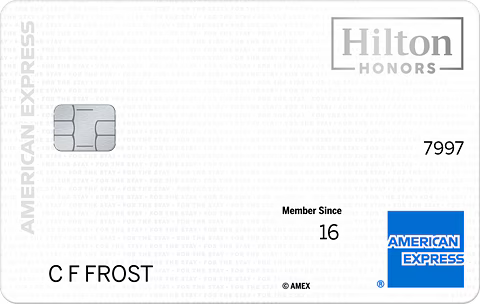
The Hilton Honors American Express Card is a no-annual-fee credit product designed for travelers who frequent Hilton-branded properties. The card serves as the entry point to American Express’s Hilton co-branded lineup, which includes the Surpass and Aspire cards.
It is structured for individuals who seek a mechanism to earn hotel points and maintain loyalty status within the Hilton Honors ecosystem—which includes brands like Conrad, Waldorf Astoria, DoubleTree, and Hampton—without incurring a recurring yearly membership fee.
How the Rewards System Works
The card operates within the Hilton Honors loyalty program. Points earned through spending are automatically deposited into the cardholder’s Hilton account, where they can be redeemed for hotel stays, travel experiences, or partner transfers.
Earning Tiers
The card employs a tiered structure that prioritizes Hilton-specific spending while also providing bonuses for common domestic categories:
- Hilton Portfolio: Earns 7 Hilton Honors bonus points for each dollar of eligible purchases charged directly with a hotel or resort within the Hilton portfolio.
- Everyday Domestic Bonus Categories: Earns 5 Hilton Honors bonus points for each dollar of eligible purchases at U.S. restaurants, U.S. supermarkets, and U.S. gas stations.
- General Purchases: Earns 3 Hilton Honors bonus points for each dollar of all other eligible purchases.
While the “3x” base rate appears high relative to other cards, the real-world value of a Hilton Honors point is typically lower than that of general-purpose points or airline miles (frequently valued at approximately 0.4 to 0.6 cents per point).
Redemption Mechanics
Hilton Honors uses a dynamic pricing model for Reward Stays. The number of points required for a room fluctuates based on the hotel, its location, the time of year, and current demand. There are no blackout dates for Reward Stays; if a standard room is available for cash, it is typically available for points.
Cardholders can also use “Points & Money” to book stays using a combination of rewards and currency, or use points for Amazon.com purchases and car rentals (though these often provide lower value than hotel redemptions).
Automatic Hilton Honors Silver Status
A defining feature of the card is the automatic provision of Hilton Honors Silver status. This status is maintained as long as the cardholder remains an active member of the card program.
Silver Status Benefits
Silver status is the initial tier above base membership. It provides several mechanisms for enhanced points accumulation and stay efficiency:
- 20% Bonus: Earns a 20% bonus on base points earned during hotel stays.
- Fifth Night Free: When booking a standard room stay of five or more consecutive nights using 100% points, the fifth night is provided at zero point cost. This benefit can be utilized across multiple stays per year.
- Complimentary Bottled Water: Two bottles of water per stay at participating hotels.
- Elite Rollover Nights: Allows unused nights beyond the status qualification limit to roll over into the next calendar year.
The “Fifth Night Free” benefit is high-value for travelers who plan multi-night stays, as it effectively reduces the point cost of a five-night trip by 20%.
Path to Gold Status
The card includes a mechanism for users to “spend their way” to a higher loyalty tier without upgrading to a card with an annual fee.
Spending Threshold
If a cardholder spends $20,000 on eligible purchases in a calendar year, they are upgraded to Hilton Honors Gold status through the end of the next calendar year.
Gold status provides a significant increase in benefits over Silver, including an 80% point bonus, space-available room upgrades (up to Executive floor), and a daily food and beverage credit (at U.S. hotels) or complimentary breakfast (at non-U.S. hotels). Achieving this via spending allows the cardholder to avoid the annual fees associated with Gold-tier cards like the Surpass or Amex Platinum.
Auxiliary Features and Protections
As an American Express product, the card includes several features tied to the Amex network and the issuer’s customer service infrastructure.
Card Benefits and Protections
- Amex Offers: Access to targeted discounts or bonus point offers for spending at specific merchants.
- Send & Split®: A feature within the Amex App that allows cardholders to send money to or split purchases with other Venmo or PayPal users.
- Global Assist Hotline: Provides 24/7 coordination and assistance services when traveling more than 100 miles from home (legal, medical, or emergency assistance). NOTE: Third-party service costs are the cardholder’s responsibility.
- Car Rental Loss and Damage Insurance: Provides secondary coverage for damage to or theft of a rental vehicle when the card is used to pay for the rental and the carrier’s insurance is declined.
Financial Structures and Costs
The card is positioned as a low-commitment entry point for travelers.
Cost Breakdown
- $0 Annual Fee: No recurring yearly charge.
- No Foreign Transaction Fees: The card does not charge fees for purchases made in international locations or in foreign currencies.
- Variable APR: The interest rate for purchases is variable and tied to the Prime Rate. As with most rewards cards, carrying a balance results in interest charges that can quickly exceed the value of any points earned.
Intended User Profile
The Hilton Honors American Express Card is structured for:
- Occasional Hilton Guests: Travelers who stay at Hilton properties once or twice a year and want to ensure those stays contribute to a points balance that does not expire.
- U.S.-Based Everyday Spenders: Individuals who spend significant amounts at U.S. supermarkets, restaurants, and gas stations and prefer a high volume of points over cashback.
- Diversified Travelers: Users who primarily use other loyalty programs but want a no-cost “backup” status and a way to earn Hilton points for specific redemptions.
Tradeoffs, Risks, and Limitations
Point Value Sensitivity
Hilton points are highly sensitive to dynamic pricing. A hotel that costs 40,000 points today may cost 60,000 points next week based on demand. Because the card earns Hilton-specific points, the “savings” are tethered to Hilton’s internal valuation of its rooms.
Lower Earning Power vs. Fee-Based Cards
While 7x points at Hilton properties is a solid entry-level rate, the Hilton Surpass (which has an annual fee) earns 12x points and includes automatic Gold status. High-frequency Hilton guests may find that the extra points and Gold-tier benefits (like breakfast credits) provide hundreds of dollars in value that far outweigh a $150 fee.
Opportunity Cost of Base Spending
The “3x” earning rate on general purchases may be misleading. If Hilton points are valued at 0.5 cents, the 3x rate is equivalent to a 1.5% return. This is lower than the 2% return provided by many flat-rate cashback cards.
Domestic Category Restrictions
The 5x bonus categories (supermarkets, restaurants, gas) are restricted to U.S. merchants. International spending in these categories will typically earn only the base 3x rate.
Regional and Regulatory Frameworks
The Hilton Honors American Express Card is a U.S. consumer credit card. It is subject to U.S. federal lending laws, including the Truth in Lending Act. Issuance is limited to U.S. residents, and American Express uses its own proprietary credit scoring models for approval.
Common Misconceptions
“This card gives me a free night certificate every year.”
The basic Hilton Honors Amex does not include an annual free night award. These awards are benefits associated with the Hilton Surpass (after $15k spend) and the Hilton Aspire (automatic).
“I get free breakfast at Hilton with this card.”
Silver status does not include free breakfast or food and beverage credits. These benefits begin at the Gold status level.
“The 100,000 point welcome bonus will get me 10 free nights.”
While Hilton has some low-tier properties, most mid-range hotels (Hampton Inn, Hilton Garden Inn) cost 30,000 to 50,000 points per night. A 100,000-point bonus typically translates to 2–3 nights in a standard U.S. hotel.
“Amex is accepted everywhere internationally.”
While acceptance is broad, American Express is less universally accepted outside the United States than Visa or Mastercard. Travelers should carry a backup payment method when traveling abroad.