
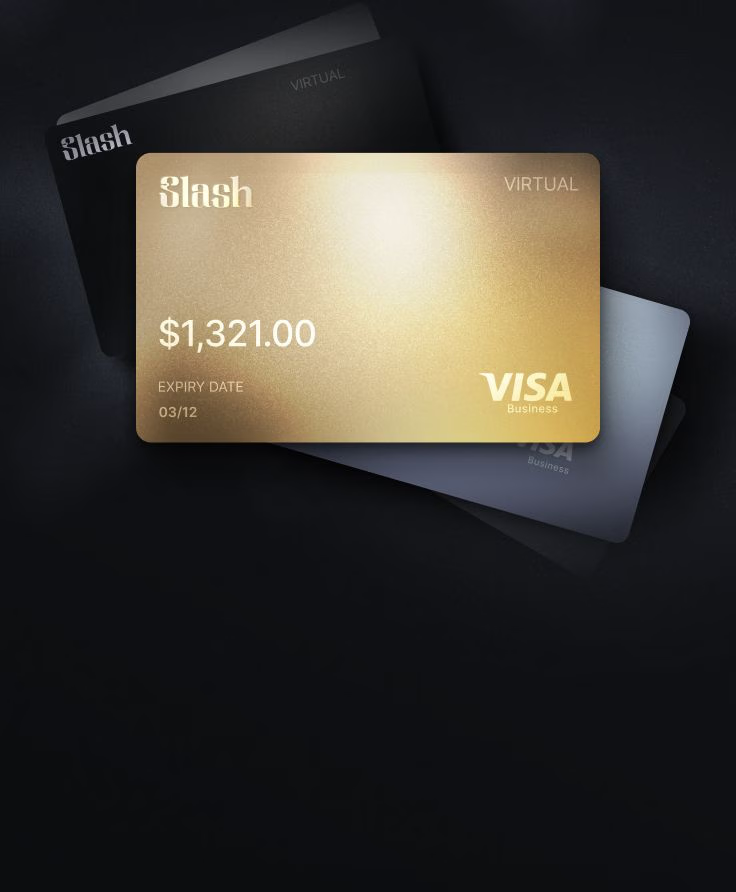
Slash operates a corporate charge card aimed at businesses with concentrated advertising spend, particularly on Meta. The card pays a flat cashback rate that increases on a paid tier, plus a separate rebate on ad invoice payments routed outside the card network. This review covers how the card and account are structured, how rewards and fees work, and where the product’s eligibility and liquidity limits sit.
What the Slash card is structurally
The Slash card is a charge card tied to a Slash business account rather than a standalone credit product. Slash issues virtual and physical cards against the business’s cash balance and underwriting profile, not a traditional revolving credit line.
The card sits inside a broader dashboard that also handles ACH, wire, FedNow, and SWIFT transfers for vendor and ad-platform payments. Cards can be issued in bulk and grouped by team or ad account, so individual campaigns or vendors can be isolated on separate card numbers.
As a charge card, the balance is not designed to carry over indefinitely. The business is expected to hold enough cash in its linked balance to cover the spend it authorizes.
Slash is a financial technology company rather than a bank. Card issuance, fund custody, and regulatory compliance for the underlying account are handled by Slash’s partner bank, while Slash operates the dashboard, underwriting logic, and rewards programs on top of that infrastructure.
How the card and account work in practice
A business opens a Slash account and links its cash position, which Slash uses to set the card’s spending capacity. Administrators can create card groups, assign budgets, and issue cards to specific ad accounts or vendors from the same dashboard.
Card-based purchases earn cashback automatically at the account’s current rate. Separately, ad invoice payments made through ACH, wire, FedNow, or SWIFT — rather than through the card itself — qualify for a distinct rebate under Slash’s Meta ad invoice program.
Both rebates are credited as cash to the Slash account balance rather than as a points balance or statement credit. This keeps the reward liquid and immediately usable for further spend or transfer.
Fees and pricing mechanics
Slash’s standard accounts earn a flat 1.5% cashback rebate on card purchases, with no monthly account fee. Accounts on the Pro tier earn 2% cashback instead, and the Pro tier carries a $25 monthly fee.
The Meta ad invoice program pays 1% cashback on eligible ad invoice payments processed outside the card network, through ACH, wire, FedNow, or SWIFT. This rebate runs alongside, not instead of, the card’s standard or Pro cashback rate.
Because the Pro tier’s incremental 0.5% cashback must offset its $25 monthly fee, the tier’s cost only nets a benefit once card spend passes a few thousand dollars a month. Slash generates revenue from interchange fees and from the Pro tier’s subscription charge.
Limits, eligibility, and availability
The Slash card is available only to U.S.-registered businesses, including LLCs and corporations, that hold an active Slash business account. Both the 2% Pro rate and the Meta ad invoice rebate require that active account relationship rather than a card alone.
Slash sets spending capacity from the business’s linked cash balance and transaction history rather than from a personal credit check. The company states it does not require a personal guarantee from the business owner.
Card issuance and underwriting depend on the business maintaining sufficient linked cash and standing with Slash. Businesses outside the United States, or without a qualifying business entity, are not eligible.
The application is submitted online, and approval depends on the financial data the business connects during setup rather than a personal credit inquiry.
Tradeoffs and limitations
The charge card structure requires the business to pay its balance in full rather than revolve it across billing cycles. A business facing a temporary cash shortfall cannot rely on the Slash card as a source of extended credit.
The 2% rate is contingent on the $25 monthly Pro fee, which is a fixed cost regardless of spend volume. At low monthly spend, that fee can exceed the additional cashback the Pro tier generates over the standard 1.5% rate.
The Meta ad invoice rebate applies specifically to ad invoice payments processed outside the card network, not to card purchases at Meta or to invoice payments to other ad platforms. Businesses whose ad spend runs through other channels do not receive this additional 1% rebate.
Because rewards and credit capacity are tied to an active Slash business account, closing or downgrading that account removes access to both the Pro rate and the invoice rebate. The card’s underwriting model also depends on continued visibility into the business’s linked cash balance, so businesses that hold cash outside Slash’s linked accounts may see a more conservative spending capacity.
The platform’s spend-management tools, such as card groups and per-card budgets, are built around businesses that route a large share of spend through Slash. A business that splits its card volume across multiple providers gets a smaller view of its total spend inside any single dashboard, including Slash’s.
More detail on the card’s terms and current rates is available on Slash’s official site.
See also: Corporate Card Rewards: Comparing Points vs. Flat Cashback, Ramp Corporate Card Review