

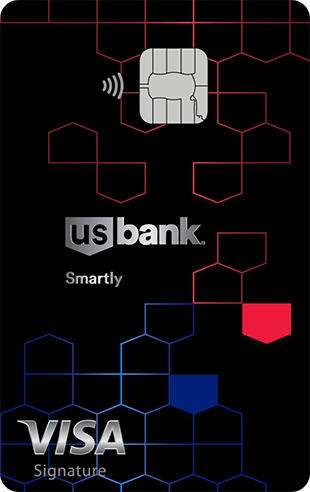
The U.S. Bank Smartly™ Visa Signature® Card is a credit product that integrates card spending with a broader banking relationship. It utilizes a rewards engine that scales based on the assets a cardholder maintains within the U.S. Bank ecosystem.
While many cards offer flat or category-based rewards, the Smartly card uses “relationship-based” mechanics. This means the value of the rewards is not just a function of spending, but also a function of the user’s total balance in checking, savings, and investment accounts.
What the U.S. Bank Smartly Visa Signature Card Is (Overview)
The Smartly card is a Visa Signature credit card issued by U.S. Bank. It combines traditional revolving credit features with a rewards program that incentivizes “full-wallet” banking.
The product is defined by its connection to the “Smartly” suite of products, which includes a checking account and a savings account. The card acts as the primary spending tool in this ecosystem, while the banking accounts serve as the “multiplier” for rewards earned on that spending.
As a Visa Signature product, it also includes a standardized set of benefits common to premium cards, such as travel and emergency assistance, though the primary value proposition is the variable rewards rate.
How the Tiered Rewards Mechanism Works
The “Smartly Earning Bonus” is the core mechanism of the card. It consists of a base earning rate and a bonus rate determined by the cardholder’s “qualifying balance.”
-
Base Rewards Accrual Every eligible purchase made with the card earns 2% in rewards (accrued as 2 points per $1 spent). This base rate applies regardless of the user’s banking relationship. Like most cards, this excludes cash advances, balance transfers, and fees.
-
The Qualifying Balance Calculation The system calculates a monthly average balance across eligible U.S. Bank accounts. These accounts include Smartly Checking, Smartly Savings, and U.S. Bancorp Investments accounts. The balance is a “snapshot” that determines the bonus tier for the following period.
-
Tier Thresholds and Multipliers The engine applies different bonus rates based on the qualifying balance:
- $10,000 to $49,999: The total reward increases to 2.5%.
- $50,000 to $99,999: The total reward increases to 3%.
- $100,000 or more: The total reward increases to 4%.
-
Spending Caps on Bonuses The bonus multipliers only apply to the first $10,000 in eligible net purchases per billing cycle. Spending beyond this limit reverts to the base 2% rate. This cap is a system-level constraint designed to manage the issuer’s liability for high-spend accounts.
How Rewards Are Redeemed and Managed
Rewards are earned as points within the U.S. Bank rewards system. The management of these points involves several rules and redemption paths.
Conversion to Cash
Points are typically worth 1 cent each when redeemed as a deposit into a U.S. Bank checking or savings account. This 1,000 points = $10 conversion is the standard system logic for “cash back” cards.
Alternative Redemption Paths
Users can also choose to redeem points for statement credits, gift cards, or travel. However, the value of the points may vary depending on the chosen path. The system is optimized to encourage redemption back into the U.S. Bank ecosystem.
Point Expiration Logic
Rewards do not expire as long as there is card activity. However, if an account shows no reward, purchase, or balance activity for 12 consecutive statement cycles, the system may purge the accumulated points. This “dead account” logic is a standard risk management practice in reward systems.
How the Card Generates Costs and Ecosystem Dependencies
The Smartly card is designed to lock users into a specific banking relationship. This “sticky” mechanism creates secondary costs and tradeoffs.
Account Maintenance Fees
While the card itself has no annual fee, the linked Smartly bank accounts may have monthly maintenance fees. These fees are often waived if certain criteria are met (like having the Smarly credit card), but they represent a potential cost if the user’s relationship with the bank changes.
Foreign Transaction Fees
The card charges a 3% fee on purchases made outside the U.S. or in foreign currencies. For a user at the base 2% reward tier, this results in a net loss on international transactions. Even at the 3% or 4% tiers, the foreign fee significantly erodes the reward margin.
Interest and APR Mechanics
If a cardholder carries a balance, the system applies a variable APR to the average daily balance. Because credit card interest rates are typically much higher than the interest paid on savings accounts, carrying a balance effectively subsidizes the rewards of other cardholders.
Practical Implications of Relationship Banking
Integrating a credit card with a bank’s deposit side changes the user experience in several ways.
Increased Monitoring Requirements
To maintain the 3% or 4% reward rates, a user must actively monitor their qualifying balances. If a balance drops below a threshold (e.g., due to a market fluctuation in an investment account), the system automatically reduces the reward rate for the next period.
Reduced “App Switching”
The Smartly ecosystem is designed to reduce the need for multiple banking apps. A user can see their credit card balance, rewards, and checking balance in one interface. This convenience is a primary driver of the “full-wallet” strategy.
Impact on Financial Flexibility
The requirement to maintain high balances at one institution may limit a user’s ability to chase higher yields or better loan terms at other banks. This is the “opportunity cost” of the tiered rewards system.
Tradeoffs, Risks, and Limitations
The U.S. Bank Smartly card is not a universal product. It has specific constraints that limit its appeal to broad segments of consumers.
- Capital Lock-up: The highest reward tier (4%) requires $100,000 in assets. For many users, this capital may be better deployed elsewhere, even with the 4% cashback offset.
- Complexity of Calculation: The monthly balance snapshot and the $10,000 spending cap on bonuses add layers of complexity that are not present in flat-rate cards.
- Credit Approval Filters: Like other premium Visa Signature cards, the underwriting system prefers applicants with “excellent” credit scores, often 720 or higher.
- Platform Dependency: Both the rewards and the account management are heavily dependent on the U.S. Bank mobile and web platforms.
Regional and Regulatory Differences (United States)
This product is specific to the United States and is governed by U.S. banking and credit laws. The Truth in Savings Act (TISA) governs the disclosure of the linked bank accounts, while the Truth in Lending Act (TILA) governs the credit card.
The system’s ability to offer 4% cashback is highly dependent on the “interchange” environment in the U.S. In regions like the European Union, where interchange fees are capped at 0.3%, a 4% rewards rate would be mathematically impossible for an issuer to sustain.
Common Misconceptions About the Smartly Card
“It’s a 4% cashback card.” This is only true for the first $10,000 in monthly spending for users who maintain over $100,000 in qualifying assets. For others, it is effectively a 2%, 2.5%, or 3% card.
“Investment losses don’t affect my rewards.” If the value of an investment account drops and pushes the “qualifying balance” into a lower tier, the rewards engine will automatically adjust the cashback rate downward.
“The bonus applies to all spending.” The bonus rate only applies to “eligible net purchases.” It does not apply to things like cash advances or balance transfers, and it is capped at $10,000 per cycle.
“The banking accounts are free.” The accounts required for the bonus tiers may have their own fee structures. While these fees can often be waived, they are a separate mechanism that must be managed alongside the card.