

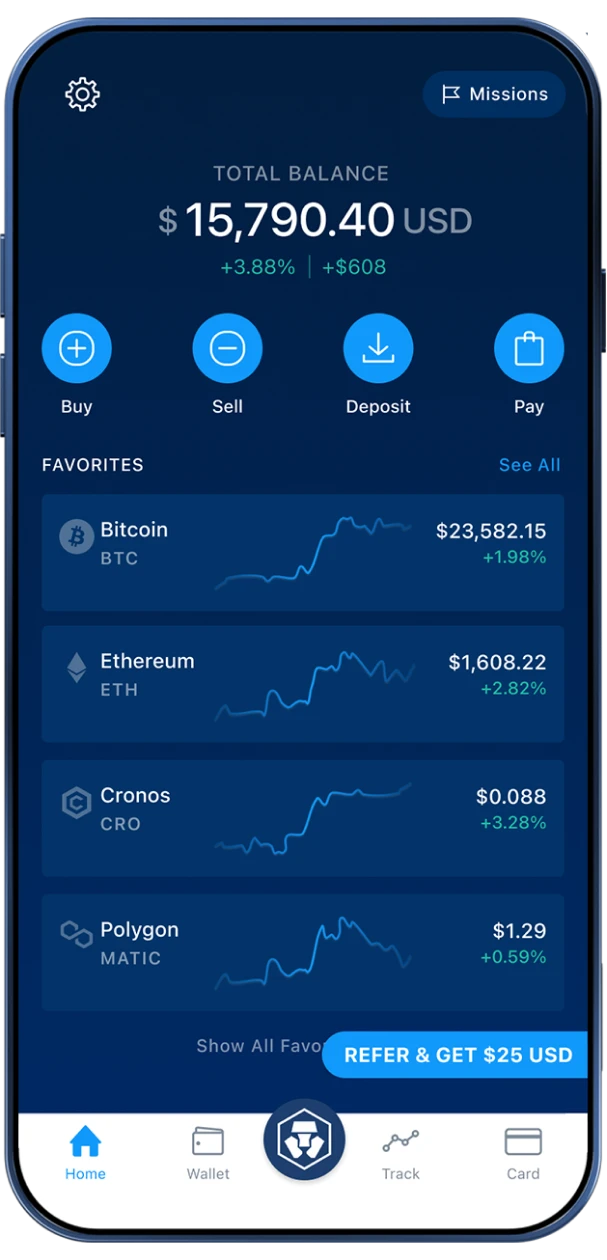
Crypto.com is a custodial crypto platform with an app quote, an exchange order book, and a prepaid Visa card. The app price includes a spread. The exchange charges maker and taker fees from a published schedule.
Fee and card figures below are the USD schedules as of October 15, 2026. Other countries use local schedules.
How is Crypto.com structured as a digital asset ecosystem?
Crypto.com splits retail activity across an app, an exchange, and a card. More than one licensed company sits behind those products. Foris DAX, Inc., a Delaware corporation, provides the U.S. app and is a registered money services business.
The licenses page lists U.S. money transmitter licenses, a broker-dealer registration, and a national trust bank charter marked conditional approval. Its EEA entries include an electronic money institution license and a MiCA Class 2 crypto-asset service provider license.
U.S. app terms exclude residents of New York. Level Up CRO staking is unavailable in New York, California, Maryland, New Jersey, and Wisconsin. Where staking is not offered, Level Up uses a CRO lockup instead.
Private keys for customer crypto are stored online and offline. The security page describes controls on cold wallets and hot wallets, and says platform assets are held one-to-one.
A withdrawal can wait while keys are retrieved from offline storage. The U.S. terms say that wait can run 48 hours or more.
U.S. dollar balances for U.S. residents sit at Community Federal Savings Bank or another listed FDIC-member bank. FDIC insurance covers those dollars up to $250,000 if that bank fails.
It does not cover a Crypto.com failure. It does not cover cryptocurrency.
The prepaid Visa card is issued by Community Federal Savings Bank under a Visa license. A card balance is not a checking or savings account at that bank.
CRO is the platform token. Level Up is the membership that sets the card tier. Basic has no subscription and no CRO lock.
Plus and Pro use a subscription or a 12-month CRO lock or stake. Private uses only the 12-month CRO lock or stake.
How do the mobile app and exchange function in practice?
The app and the exchange keep separate balances. On the app, Crypto.com is the counterparty. The customer accepts a quote.
U.S. terms say the quote includes a markup or markdown. That amount is a spread. An admin fee can apply with the spread.
The admin fee varies with market conditions, promotions, volatility, and liquidity. The trade preview shows the fee before the order is submitted.
The exchange runs a central limit order book. Limit orders, market orders, and stop-loss orders are listed in the exchange help topics. A matched trade settles on the exchange ledger.
An on-chain send happens when the customer withdraws.
The prepaid Visa card spends fiat loaded onto the card. Cryptocurrency cannot sit on the card. Crypto moved to the card is converted to local currency at the load.
A Visa Signature credit card is a separate product for eligible U.S. users.
What are the fees and trading costs on the platform?
As of October 15, 2026, the Exchange fees and limits page prices spot trades from trailing 30-day volume. The rows below are the published rates with no CRO balance.
| 30-day spot volume (USD) | Maker fee | Taker fee |
|---|---|---|
| Under $10,000 | 0.250% | 0.500% |
| $10,000 and above | 0.200% | 0.400% |
| $50,000 and above | 0.150% | 0.250% |
| $250,000 and above | 0.100% | 0.200% |
| $500,000 and above | 0.080% | 0.180% |
A CRO balance on the exchange can reduce those rates. At a balance of at least 50,000 CRO, that page lists 0% maker fees and taker fees 12% below the base rate. The benefit depends on the CRO balance and can instead be a smaller discount or a maker rebate.
The exchange-pro fees pages list the same base rates with a 3% cut on both the maker fee and the taker fee. Rates refresh at 04:00 UTC from volume, maker activity, and CRO balance. A forced liquidation adds a 0.5% fee.
The app does not publish one spread percent. The spread sits inside the quote. Any admin fee is the amount on the preview.
U.S. ACH deposits carry no Crypto.com fee. The sending bank may charge its own. The transfer has to come from a bank account in the customer’s own name.
The minimum is $1. The daily maximum is $1,000,000 or 5 transfers. The monthly maximum is $10,000,000 or 30 transfers.
The USD balance cap on that help page is $10,000,000. Prime users have no Crypto.com balance cap. The sending bank’s limit still applies.
On the U.S. prepaid card, a debit-card load costs 1% and a credit-card load costs 2.99%. Those load fees are separate from the app admin fee. ATM withdrawals above the monthly free amount cost 2%.
Midnight Blue, Ruby Steel, Jade Green, and Royal Indigo pay 3% on non-USD purchases and ATM withdrawals. Rose Gold, Icy White, and Obsidian list no foreign transaction fee. After 12 months with no cardholder activity, the inactivity fee is $5.95 a month, effective September 1, 2026, on the U.S. card fees and limits page.
The USD card comparison lists these Level Up prices and everyday CRO spend rewards. Some merchant categories are excluded from the spend reward. The card page says those reward terms can change.
| Plan | Published price | CRO back on everyday spend |
|---|---|---|
| Basic (Midnight Blue) | No subscription and no CRO lock | 0% |
| Plus (Ruby Steel) | $4.99 a month, $49.90 a year, or $500 of CRO for 12 months | 1.5% on the first $750 in a month |
| Pro (Jade Green or Royal Indigo) | $29.99 a month, $299.90 a year, or $5,000 of CRO for 12 months | 2.5% on the first $1,500 in a month |
| Private (Icy White or Rose Gold) | $50,000 of CRO for 12 months | 3.5% on the first $3,000 in a month, then 0.5% |
| Private (Obsidian) | $500,000 of CRO for 12 months | 4.5% on the first $5,000 in a month, then 1% |
Who can open a Crypto.com account and what are the limits?
A U.S. card application asks for name, address, date of birth, and a Social Security number or another identification number. A photo ID may be requested. Residents of New York are outside the U.S. app terms.
The U.S. prepaid card balance cap is $25,000 on every tier. Midnight Blue has a combined monthly cap of $15,000 across purchases, ATM withdrawals, and card-to-card transfers. Metal cards have a combined monthly cap of $25,000 on that same set.
Monthly free ATM amounts are $200 on Midnight Blue, $400 on Ruby Steel, and $800 on Jade Green and Royal Indigo. Icy White, Rose Gold, and Obsidian list $1,000 free each month. The monthly ATM cap is $5,000 on Midnight Blue and $10,000 on the other tiers.
Daily ATM caps are $500 on Midnight Blue, $1,000 on Ruby Steel, and $2,000 on Jade Green and Royal Indigo.
A new Level Up CRO stake uses a 365-day lock and cannot be unstaked during that lock. Unstaking after the lock starts an unbonding period of about 36 days. Staking rewards stop during that wait.
Unlocking without a subscription moves the plan to Basic. A missed subscription payment does the same. Raising a CRO lock to a higher plan restarts the 365 days.
What risks and utility tradeoffs does the ecosystem carry?
CRO in a 365-day Level Up lock cannot be sold while the lock runs. The dollar value of that CRO can move during the lock. Spend rewards are paid in CRO, so their dollar value moves with the CRO price.
Staking reward figures on the Level Up page are estimates and can change.
Plus and Pro can be held with a subscription instead of locked CRO. Private, at $50,000 or $500,000 of CRO, is a 12-month lock or stake. Ending the lock without a subscription moves spend rewards to the Basic rate of 0%.
There is no single published app spread. The quote includes one, and the preview shows any admin fee for that order. U.S. dollar balances can sit at an FDIC-member bank, up to $250,000 if that bank fails.
That coverage does not extend to a Crypto.com failure. It does not cover cryptocurrency.
The 24-hour withdrawal lock is a setting, not a permanent rule. When it is on, a newly whitelisted address cannot receive a withdrawal for 24 hours. Turning it off takes effect after 24 hours.
Common questions
Is the Crypto.com card a credit card?
The Visa card covered here is a prepaid card. Purchases spend a loaded fiat balance, with no credit line. A separate Visa Signature credit card is offered to eligible U.S. users.
Can locked CRO be withdrawn early?
A Level Up CRO stake cannot be unstaked during its 365-day lock. After the lock, unstaking waits about 36 days, and staking rewards stop during that wait. Plus and Pro also have a subscription that does not lock CRO.
How does a cash deposit work?
A U.S. customer starts an ACH transfer from a same-name bank account, and Crypto.com charges no fee while the sending bank may charge a separate fee. Published limits are a $1 minimum, $1,000,000 or 5 transfers a day, and $10,000,000 or 30 transfers a month. The ACH help page does not list cash deposits at a retail counter.