

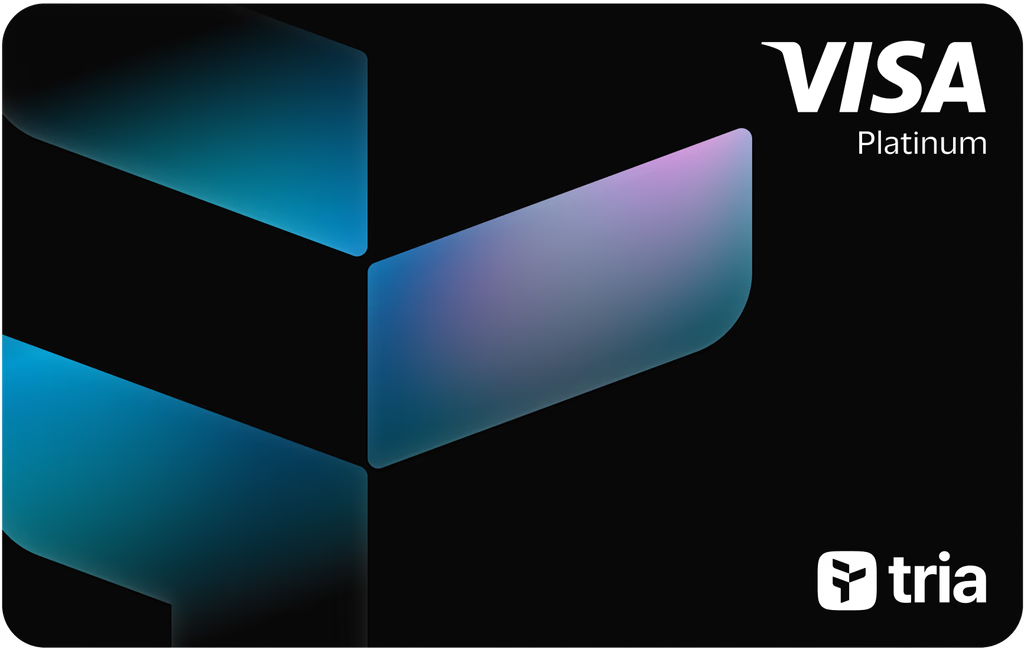
Tria is a self-custodial finance app with a Visa card and a cashback schedule that changed names on October 3, 2026. The membership post maps Virtual to Lite, Signature to Pro, and Premium to Max. The app is not a bank, and card cashback is a program credit rather than interest on a deposit.
The October 3, 2026 posts from the official Tria account use the same three names and the same cashback bands as the blog. Fee documents published before and after that date do not all use the same Lite price or the same Pro cap. This review records those documents side by side.
What Tria is structurally
Tria is a self-custodial wallet and card interface, not a licensed bank. The account holder keeps a key share for wallet assets. Card spending still runs through a card partner and a KYC check, which is separate from custody of the wallet.
Current help and the October 2026 membership post describe the product through card tiers and cashback. They do not restate an older BestPath AVS write-up as the live settlement path. Network coverage and the token list are whatever the app shows at funding time.
Cashback, once it is paid, is denominated in USDT on Arbitrum and has to be claimed in the app. That is a stablecoin credit on a named network, not a dollar posted to a bank account. The help center’s cashback article was updated in October 2026.
How Tria works in practice
A cardholder spends on the Visa card, and eligible purchases accrue cashback after the charge settles. The cashback help article says the credit is not instant. It describes a waiting period of up to 90 days, a claim step in the app, and payout in USDT on Arbitrum.
The same article says caps reset at the start of each month and apply per user across connected cards. Refunds deduct cashback earned on the returned amount. A tier change applies to later purchases, not to charges that already settled.
Cash withdrawals, money transfers, prepaid or wallet funding, gambling, and some voucher purchases are excluded. Spending on Tria Travel is excluded because that flow has a separate reward program. The help text also mentions a quarterly schedule tied to a token-generation event, which sits next to the 90-day waiting language rather than replacing it.
Fees and pricing mechanics
The October 2026 rename post is the source for the new names and for one version of the bands.
| Previous name | Name now | Rate inside the monthly band | Rate after the band | Price in that post |
|---|---|---|---|---|
| Virtual | Lite | 1.5% on the first $1,000 | 0.5% with no stated stop | $20 a year, after a free Virtual offer ended |
| Signature | Pro | 4.5% on the first $1,000 | 1% with no stated stop | Not given in the post |
| Premium | Max | 6% on the first $2,000 | 1% with no stated stop | Not given in the post |
The cashback help article, updated in the same month, uses different Pro and Lite figures. It calls Lite a free card at 1.5% up to $1,000 a month, then 0.5%. It puts Pro at 4.5% up to $2,000 a month, then 1%, and Max at 6% up to $2,000 a month, then 1%.
A renewal FAQ lists Lite renewal at $0, Pro at $109 a year, and Max at $250 a year. U.S. card terms last updated January 9, 2026 still show annual fees of $25, $109, and $250 for the Virtual, Plastic, and Metal products. Those terms also list an international transaction fee of up to 3%, an ATM withdrawal fee of up to $2 plus 3%, and ATM inquiry or decline fees of up to $2.
The in-app price is the amount that posts at renewal. The public pages do not currently collapse to one Lite price.
Limits, eligibility, and availability
The published numeric limits in these sources are the cashback bands, not a single daily retail cap. Caps reset monthly and apply across cards on the account. The highest band in the rename post is Max at 6% on the first $2,000, then 1%.
A virtual or physical card requires identity verification. The January 2026 U.S. terms are a regional disclosure, so other countries can sit on a different fee card. The app is the availability check.
XRP Ledger support was announced by the official account on September 30, 2026 as a funding and trading rail. That post is not a change to the cashback table.
Tradeoffs, risks, or limitations
Self-custody means a lost key share is not repaired by a password reset. Tria is not an FDIC or FSCS deposit taker. Smart-contract and device risk sit with the wallet even when the card charge itself is a Visa authorization.
Cashback is delayed, paid in USDT, and reversible on refunds. Two official pages disagree on whether Pro’s higher rate covers the first $1,000 or the first $2,000 each month. Two official pages also disagree on whether Lite is $20 a year, free, or a $0 renewal.
Older marketing that described stablecoin yields around 15% is not the schedule in these October 2026 card documents. The live reward published here is the card cashback table.
Common questions
Is Tria a bank?
No. Tria is a technology app and a self-custodial wallet with a card partner. It does not take insured deposits.
What are Lite, Pro, and Max?
They are the October 3, 2026 names for Virtual, Signature, and Premium. Lite is the 1.5% band, Pro is the 4.5% band, and Max is the 6% band, each with a lower rate after the monthly threshold.
Do merchant purchases add a separate gas fee at the terminal?
Card purchases are Visa charges. The cashback help article does not add a per-swipe gas line. Wallet transfers can still pay network fees, including on the Arbitrum payout of USDT cashback.
Common misconceptions
“The October rename changed every rate.” The rename post says the 1.5%, 4.5%, and 6% rates stayed put. What changed in that post is the Lite band width, from $100 to $1,000, and the end of a free Virtual offer.
“Help-center and blog caps are the same number.” They are not. The blog caps Pro at $1,000. The help article caps Pro at $2,000. Both pages are Tria’s.
“Cashback arrives with the receipt.” The help article says cashback waits for settlement and can take up to 90 days before it is claimable in USDT.