
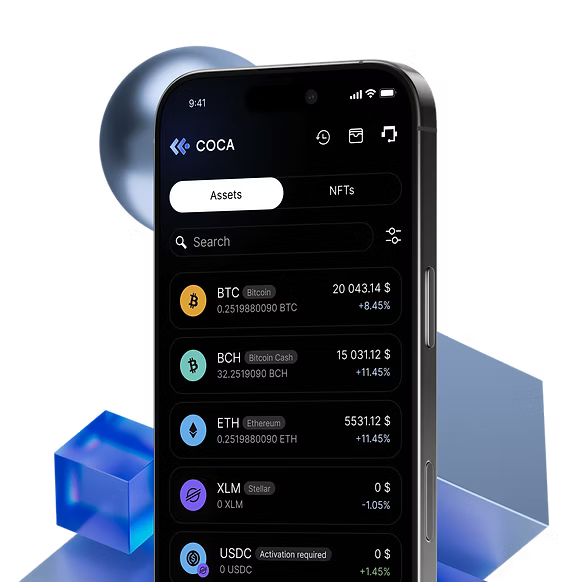
COCA is a wallet and card app that pays cashback on card spend and quotes a yield on a USD balance. The cashback rate depends on a tier tied to COCA tokens. Public documents disagree on whether the card is Visa or Mastercard, and on whether the token balance must be staked or merely held.
The product sits next to other stablecoin cards such as Kast in the sense that both clear everyday spend on a card network. The fee mechanics are different. COCA’s published schedule is a token ladder, a claim-capacity cap, and a plastic-card price that drops to zero at Premium.
How is the COCA card structured?
The card article calls the COCA Card a debit card with a virtual card and a physical card, usable online, in apps, and in stores, including Apple Pay and Google Pay. That article’s purchase-count row says the daily count is unlimited for Visa cards. The cards page on coca.xyz says the physical and virtual cards are a prepaid Mastercard issued by Wirex Limited in the UK, or by UAB Wirex in the EEA, under a Mastercard principal membership.
On October 13, 2026, the official COCA account compared the card with KAST and called both Visa. The docs, the marketing page, and that post are all COCA’s, and they do not name one network. The agreement shown in the app names the issuer, the network, and whether the card is prepaid or debit for that region.
The tier terms describe cashback landing in stablecoins such as USDC or EURC on a self-controlled balance. COCA may instead credit the crypto wallet. The overview page says there is no annual fee. The tier terms still charge for some plastic cards.
How do tiers and cashback work?
The tier terms set six levels from a COCA token balance. Starter requires no tokens. Higher tiers list a staked token amount. A separate cashback marketing page says tiers turn on from the token balance in the wallet, with no manual stake and no lock-up, and that a balance that falls under a tier keeps the old benefits for 30 days.
| Tier | COCA tokens in the tier terms | Cashback in those terms | Plastic card | Base claim capacity |
|---|---|---|---|---|
| Starter | 0 | 1% | Virtual free, plastic $5 | $15 a month |
| Standard | 300 | 3% | Virtual free, plastic $5 | $25 a month |
| Standard+ | 1,000 | 4% | Virtual free, plastic $5 | $35 a month |
| Premium | 3,000 | 5% | Virtual free, plastic free | $60 a month |
| Premium+ | 10,000 | 6% | Virtual free, plastic free | $140 a month |
| Elite | 30,000 | 8% | Virtual free, plastic free | $350 a month |
The tier terms call the cashback unlimited at the tier rate, subject to exclusions, and they list a 5% APY on the USD banking balance at every tier. The cashback marketing page says each tier’s higher rate applies only up to a monthly spending limit, and that further spend earns 1%. It also describes the balance yield as up to 5% and variable.
Claim capacity is the monthly amount of rewards that can be claimed. The tier terms build it from a tier component plus a stake component, which is why Standard is shown as $22 plus $3. Subscription rebates of 50% are tied to a count of categories that rises with the tier. The marketing page names services in those categories, including streaming, software, and retail plans, and says the list can grow.
A Standard account spending $100 on an eligible purchase accrues $3 at the 3% rate in the tier terms, and that $3 counts against the $25 monthly claim capacity. Spend past the capacity does not become claimable in that month under the capacity rule. If the marketing page’s 1% residual rule is the one in force, spend past the monthly rate cap accrues at 1% instead. The two pages describe different brakes.
What fees and limits do the card docs list?
The card article, noted as updated about five months before October 2026, lists these purchase limits: 30,000 EUR per transaction, per day, and per month; 75,000 EUR per quarter; and 100,000 EUR per six months. ATM limits on that article are 850 EUR a day, 5,000 EUR a month, and five withdrawals a day. Free ATM withdrawals are “up to $250, 2% thereafter” per month on the card article. The overview page says zero ATM fees globally up to $200, zero FX on direct pairs, zero annual fees, and zero issue fees.
| Cost | Card article and tier terms | Overview page |
|---|---|---|
| Virtual card | Free | Zero issue fee |
| Plastic, Starter to Standard+ | $5 | Zero issue fee |
| Plastic, Premium and above | Free | Zero issue fee |
| Annual fee | Not listed as a subscription | Zero |
| ATM | Free up to $250 a month, then 2% | Free up to $200 |
| FX | Not given as a percent on the card article | Zero on direct pairs |
The $5 plastic fee and the “zero issue fee” line cannot both be the price of the same plastic card. The $200 and $250 ATM bands cannot both be the free threshold. The in-app disclosure is the price that posts.
Who can use COCA, and where?
The cards page says features depend on the country of residence and on eligibility in the legal terms. Wirex Limited and UAB Wirex, if they are the issuers for a given user, are UK and EEA entities. That does not by itself say the card is unavailable elsewhere. The docs do not print a country list in the sections used here.
Purchase limits in the card article are in euros even when cashback tables are in dollars. A user whose charges post in another currency still faces those EUR ceilings if that article is the live schedule. KYC is part of opening the wallet and ordering the card.
What tradeoffs follow from the conflicting schedules?
The token tier is the main price of a higher cashback rate. Holding or staking 30,000 COCA to reach the 8% Elite rate concentrates price risk in that token. If the token price falls, the tier terms and the marketing page disagree on how fast the tier falls with it. The marketing page allows 30 days.
Cashback that is credited in USDC or EURC is a stablecoin balance, not an insured deposit. The 5% APY line is stated as a program rate on the USD balance, and the marketing page adds that it is variable and not a locked deposit. Neither page describes FDIC or FSCS cover.
The Visa, Mastercard, and Wirex sentences are a documentation failure, not a detail to average. Until the app agreement names the network and the issuer, the public pages support more than one structure. Limits and the plastic fee have the same problem in smaller numbers.
Common questions
What is the cashback rate with no COCA tokens?
The tier terms put Starter at 1% with a $15 monthly claim capacity and a $5 plastic card. Virtual cards are free at every tier in that table.
Does COCA charge an annual fee?
The overview page says the annual fee is zero. Plastic cards below Premium cost $5 in the tier terms and in the card article.
Is the card Visa or Mastercard?
The card docs refer to Visa in the purchase-count line. The cards page says a prepaid Mastercard issued by Wirex. The official account called the card Visa on October 13, 2026.