
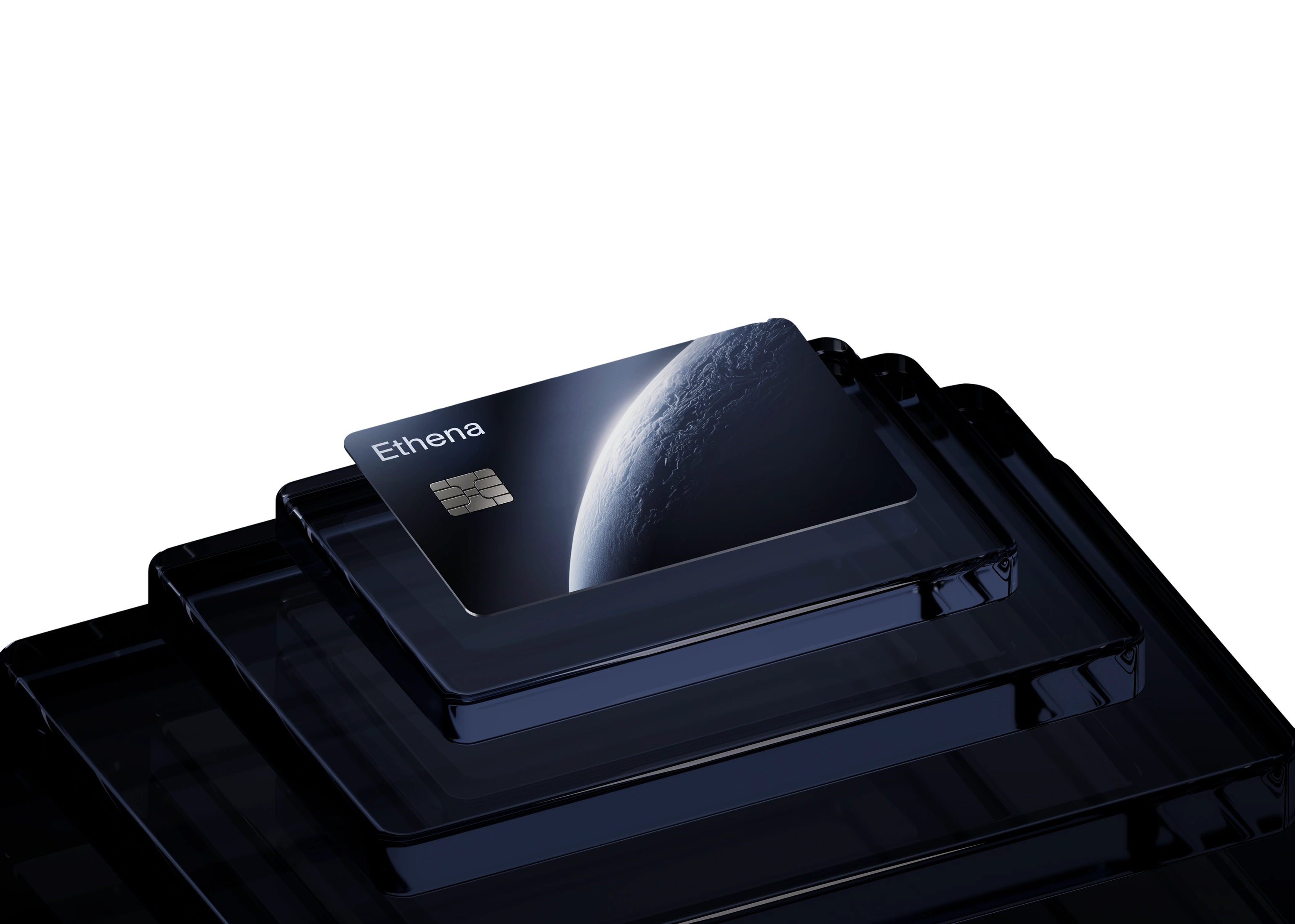
Ethena Pay is a mobile app for holding USDe, sending money, and spending on a secured card. The pricing page is effective September 1, 2026 and was last updated September 30, 2026. That page is the fee and rewards source for this review.
The app is live on iOS. The jurisdictions page lists 48 countries, and it lists the United States, the EU, the United Kingdom, Switzerland, Canada, Taiwan, and South Korea as not yet live. Access is still rolling out through a waitlist. On October 13, 2026, the official Ethena Pay account said it was adding about 100 waitlist users a day.
How is Ethena Pay structured?
The pricing page says the spend card is issued by a third-party issuer under a card-network license. Charges are secured by collateral in a linked wallet on a supported chain. Ethena Pay says it does not hold custody of that collateral.
Supported chains named for network-fee purposes are Ethereum, Polygon, Optimism, and Arbitrum. On-ramp and off-ramp partners named on the pricing page are MoonPay and Iron. There is no account-opening fee, no monthly fee, no minimum balance, no inactivity fee, and no closure fee on a standard account.
The card is a secured product with a stated 0.00% APR on purchases as of the September 30 update. The page says the issuer and Ethena Pay can add interest later, with disclosure before it applies. Cash advances, balance transfers, outbound wires, and paper statements are listed as not offered.
Sending money to another Ethena Pay user is described on the product page as free. A virtual card is free to issue, replace, and activate. Premium tiers, where they change cashback and the balance boost, are presented at enrollment. The pricing page does not print a Pro or VIP subscription price.
How do cashback and the balance boost work?
Cashback is a percentage of the U.S. dollar value of a qualifying card purchase, paid in AVAX. It is calculated after the transaction settles, then paid once a day. Settlement is described as usually one to three business days, so the AVAX credit is not on the receipt.
Each band applies only to the slice of monthly spend inside it. Crossing a band does not reprice earlier spend. The month resets at the start of the next calendar month. Purchases under $1 do not earn cashback.
| Tier | Monthly spend slice | Cashback |
|---|---|---|
| Standard | $0 to $2,500 | 4% |
| Standard | $2,500 to $4,000 | 1% |
| Standard | Above $4,000 | 0% |
| Pro | $0 to $8,000 | 4.5% |
| Pro | $8,000 to $10,000 | 2% |
| Pro | $10,000 to $12,000 | 1% |
| Pro | Above $12,000 | 0.5% |
| VIP | $0 to $20,000 | 5% |
| VIP | $20,000 to $30,000 | 2% |
| VIP | $30,000 to $40,000 | 1% |
| VIP | Above $40,000 | 0.5% |
A Standard account that spends $3,000 in a month accrues 4% on the first $2,500 and 1% on the next $500. That is $100 plus $5, credited in AVAX at the AVAX-USD rate used when the credit is calculated. ATM withdrawals, crypto and stablecoin purchases, gift cards, peer-to-peer transfers, and government payments are among the exclusions. A refund reverses the cashback.
The Daily Boost is a balance rate, separate from card cashback. The pricing page says the headline rate is the total, including the underlying USDe rate, not an extra 6% stacked on top of it. If the USDe rate rises, the boost shrinks so the total stays at the tier rate. If the USDe rate is already higher, the boost is zero.
| Tier | Total rate up to the cap | Balance cap |
|---|---|---|
| Standard | 5% a year | $5,000 |
| Pro | 6% a year | $100,000 |
| VIP | 6% a year | $1,000,000 |
Balances above the cap earn only the underlying USDe rate. The boost requires at least one qualifying card transaction in the calendar month. It is paid in USDe, generally within 24 hours after the accrual day in Central European Time. The page says the boost is not interest, not a deposit, and not insured.
What fees does the pricing page list?
Domestic USD purchases are free. There is no Ethena Pay foreign-exchange fee, no cross-border fee, and no markup on the conversion. The card network’s own conversion fee is passed through, described as typically about 1% and not as a cap.
| Fee | Amount |
|---|---|
| Account opening and monthly | $0 |
| Virtual card | $0 |
| USD purchase | $0 |
| Non-USD conversion | Network fee, typically about 1%, no Ethena markup |
| ATM, where available | $1.00 plus 0.65%, plus any operator surcharge |
| Late payment | Up to $40 |
| Returned payment | Up to $29 |
| APR on purchases | 0.00% as of September 30, 2026 |
ATM access depends on the card, the device, and the country. Cash withdrawals do not earn cashback. Blockchain gas on Ethereum, Polygon, Optimism, or Arbitrum is extra, as are MoonPay or Iron funding fees shown at the time of the transfer.
A liquidation can deduct outstanding charges, a late or returned-payment fee, gas on the liquidation, and any gap between the USD value of the charges and the collateral. The issuer sets the collateral’s market value from a redemption price, an exchange price, or an oracle. Referral bonuses are a separate $30 AVAX credit with eligibility rules and possible caps.
Where is Ethena Pay available?
The jurisdictions page says the service is live in 48 countries across Latin America, the Caribbean, Asia and the Middle East, Africa, and Oceania. The United States, the European Union, the United Kingdom, Switzerland, Canada, Taiwan, and South Korea are in the “live soon” group on that page. Registration requires age 18 or older, and some features have extra eligibility rules.
The product page still routes new users through a download and a waitlist where the country is not open. The October 13, 2026 account post is the source for the pace of about 100 users a day. Android was described as not yet the live client in the introductory post.
What risks and limits come with the secured card?
Collateral can be liquidated to cover card charges. A stablecoin depeg or an oracle print changes the coverage of those charges. Ethena Pay does not custody the collateral, so a lost wallet key is outside a password reset.
Cashback in AVAX moves with the AVAX price between the purchase and the daily credit. Standard cashback falls to 0% after $4,000 in a month, which is a hard stop rather than a lower residual rate. Pro and VIP keep a 0.5% residual. The pages do not describe that difference as a reward for choosing a tier. It is the table.
The 6% balance rate applies only up to the cap, only with a card purchase in the month, and only as a total that includes the USDe rate. It is discretionary and can be reduced or ended. It is not a bank yield and it is not available in places where Ethena says it lacks a required license.
The 0.00% purchase APR is the current disclosure, and the same page reserves the right to add interest later. Late and returned-payment fees can still post, up to $40 and $29.
Common questions
What is the cashback on a small monthly spend?
Standard is 4% on the first $2,500 in a calendar month, paid in AVAX after settlement. Pro is 4.5% on the first $8,000. VIP is 5% on the first $20,000.
Is the 6% figure added on top of the USDe rate?
No. The pricing page says 6% is the all-in rate for Pro and VIP up to their caps. The boost is whatever is left after the underlying USDe rate.
Is Ethena Pay open in the United States and the EU?
The jurisdictions page lists both as live soon, not as live. The live set on that page is 48 countries outside that group.