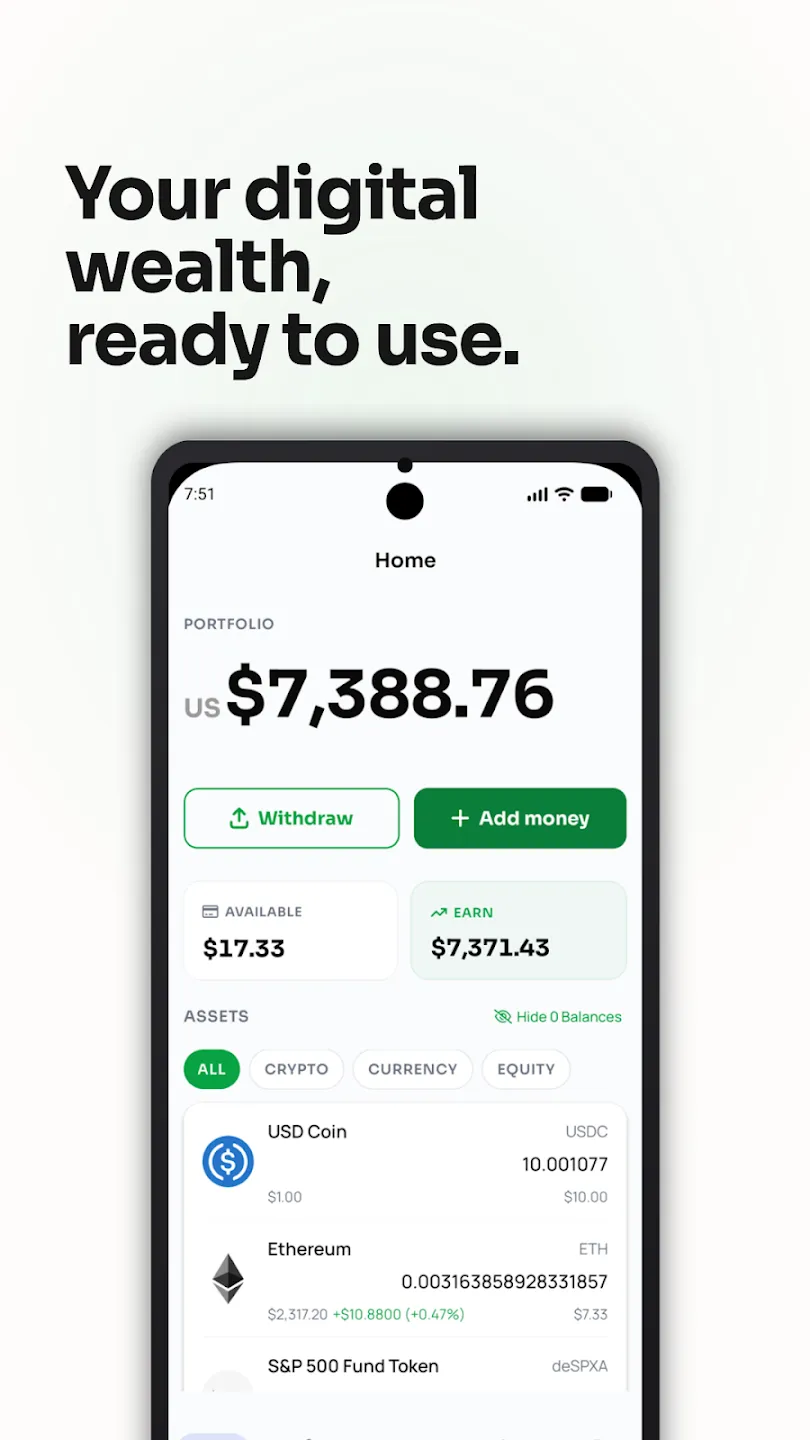


Bleap is a self-custodial finance app that combines a Mastercard debit card, on-chain balances, and limited fiat banking rails in one product. It is structured as an onchain neobank for users who want to spend stablecoins and crypto without depositing keys into a custodial exchange wallet. Bleap is not a licensed retail bank and does not offer government-insured deposits.
As of October 2026, the product targets the European Economic Area, with Latin America expansion underway. Availability depends on country eligibility and identity verification.
What is Bleap structurally?
Bleap is structured as a non-custodial wallet plus a card program, not as a traditional demand-deposit account. Users control an MPC-style wallet: no single party, including Bleap, holds a complete private key. Card spending is funded by a direct-debit style authorization against that wallet balance.
The Mastercard is issued through Unlimit (an EMI partner), not by Bleap as a bank. Where available, a dedicated EUR IBAN is provided via Monerium and is tied to on-chain e-money (EURe), not to a Bleap payment-account balance sheet. Bleap SIA holds a MiCA CASP license from Latvijas Banka (decision dated June 2026).
Balances are split for clarity. USDC and USDT deposited via Arbitrum typically credit the spendable USD cash side. EURe credits the EUR cash side. Other tokens stay in a separate crypto balance until the user converts them.
So what: the product couples self-custody with Visa-scale Mastercard acceptance, while fiat rails remain partner-dependent.
How do funding, card spend, and cashback work in practice?
Funding and spend run through cash balances, crypto conversion, and card authorization on the Mastercard network. European users can fund via SEPA and SEPA Instant to a dedicated EUR IBAN in their own name where that feature is enabled. Fiat funding options in-app may include EUR and MXN; documentation also references USD depending on region and account setup.
After verification, users can activate a free virtual Mastercard and add it to Apple Pay or Google Pay after SMS checks. A physical card is typically unlocked through the referral program (for example, free plastic after one successful invite). A limited metal card and special designs are milestone rewards, not base issuance products.
Cashback is paid in USDC after merchant confirmation, with no opt-in required. As of the Bleap cashback terms and help-center fair-usage table (updated through mid-2026, still the published schedule as of October 2026), category rates and payment-amount caps include:
| Category | Cashback rate (USDC) | Fair-usage cap (eligible spend) |
|---|---|---|
| Streaming (Netflix, Disney+, Amazon Prime, YouTube Premium) | Up to 20% | Netflix €20/mo; Prime €10/mo; YouTube €20/mo; Disney+ €200/yr |
| AI subscriptions (ChatGPT, Claude, Gemini) | Up to 20% | ChatGPT €30/mo; Gemini €20/mo; Claude €250/yr |
| Gaming (PlayStation Plus, Xbox Game Pass, Nintendo Switch Online, Steam) | Up to 20% | Xbox €30/mo; PS+ €220/yr; Nintendo €80/yr; Steam €80/yr |
| Rides (Uber, Bolt) | 3% | €50 per transaction; €500/month per service |
| Food delivery (Just Eat, Deliveroo, Uber Eats, Glovo, Bolt Food) | 3% | €50 per transaction; €500/month per service |
| Other eligible purchases | 1% | €500 per transaction; €3,000/month |
A restaurants-and-supermarkets 2% promotional window ran from 12 February 2026 through 31 May 2026 per the dated cashback terms. The help-center fair-usage table no longer lists that category as ongoing as of October 2026, while some marketing pages still mention 2% restaurants and supermarket cashback. Selected crypto and blockchain events may advertise higher event-specific rates outside the default table. Fair-usage caps limit eligible spend per merchant or category, not the cashback dollar amount itself. MCC exclusions (financial services, gambling, taxes, utilities, and similar) can block cashback even at listed merchants. Limits change. The in-app display and published terms at the time of use are the current schedule.
USD savings vaults show a variable APR or AER in the app. Site marketing has cited bands around 3.65%–3.83% AER and higher headline APY figures; an in-app view during mid-2026 testing showed about 6.52% APR on USD savings. EUR yield has been marked as coming later. Yield is not fixed and is not a bank deposit rate.
Referral milestones pay a cash reward (around $15 per invite in mid-2026 marketing) and unlock card designs or Founding Member status at invite counts such as 1, 3, 6, and 10. Milestone rewards are often time-limited.
So what: everyday use is card-first, with cashback and yield layered on top of self-custodial balances rather than a separate rewards credit product.
What fees and pricing mechanics does Bleap use?
Bleap prices primarily through optional top-up rails, processing fees shown at checkout, and network costs, not monthly membership. As of the Bleap fee schedule (updated 1 September 2026) and cardholder terms:
| Fee type | Typical charge |
|---|---|
| Virtual card issuance | €0 |
| Monthly maintenance | €0 |
| Card FX on foreign-currency purchases | 0% Bleap markup (Mastercard network rate may still apply) |
| Card spend | €0 from Bleap |
| SEPA / SEPA Instant funding (where available) | 0% platform fee in the published schedule |
| Bleap ATM fee (within free allowance) | €0 |
| Apple Pay / Google Pay top-ups | Percentage processing fee shown at checkout (commonly about 1% in mid-2026 app views) |
| Crypto buy / sell / bridge | Processing fee and possible spread built into the quote; exact fee shown before confirm |
| Cash out / sell in-app (platform) | €0 platform fee; network fees may still apply |
| On-chain transfers | Network gas shown as a separate line item |
Merchant or ATM operator surcharges can still apply outside Bleap’s own schedule. Free ATM narrative is commonly framed around about €400 per rolling 30 days and three withdrawals per month; excess activity may lose the free allowance.
So what: headline card costs are low, while checkout processing fees, spreads, and card-funded crypto buys remain the main percentage costs.
What limits, eligibility, and availability apply?
Eligibility centers on EEA residents who complete KYC; Latin America expansion is in progress and remains country-specific. The product requires identity verification before card activation and higher limits.
Card and transfer limits in the Bleap limits help article (as of June 2026, still the published table as of October 2026) include:
| Limit type | Published ceiling (approx.) |
|---|---|
| Card payment per transaction | €10,000 |
| Card payment per day | €15,000 |
| Card payment per rolling 30 days | €30,000 |
| ATM withdrawals | 3 per month; €400 per rolling 30 days |
| Incoming bank transfer | €2,000 per transfer; €5,000/day; €7,000/30 days |
| Outgoing bank transfer | €3,000 per transfer; €5,000/day; €10,000/30 days |
| Cashback withdrawals | 5 per month |
| Exchanges / trading | 30 per month each (separate counters) |
Account limits can vary by verification level; the app’s Account Limits screen is authoritative for a given user.
The dedicated EUR IBAN is oriented to incoming SEPA and SEPA Instant transfers first. As of the August 2026 dedicated-IBAN help article, outgoing transfers may still show Bleap as the sender until outbound named-IBAN support reaches that account.
So what: geographic and compliance gates matter as much as fee tables for whether the stack is usable at all.
What tradeoffs, risks, and limitations matter?
Tradeoffs concentrate on partner rails, cashback caps, and self-custody recovery—not on monthly card fees. Help-center copy describes the dedicated IBAN as able to receive payments from friends, employers, and platforms, with the sender seeing the user’s name. Earlier in-app copy instructed users to send bank transfers from their own EUR account, and a SEPA transfer from a spouse’s account failed to credit in one documented mid-2026 test. Third-party and salary EUR funding remain product-dependent until live IBAN behavior matches the user’s current docs.
Yield rates move with vault configuration and market conditions. High category cashback is constrained by fair-usage spend caps, so headline 20% rates do not scale linearly with unlimited subscription spend. Self-custody shifts key-recovery responsibility to the user; Bleap emails a recovery code after registration, which must be stored offline.
Card authorizations still depend on Mastercard acceptance, partner uptime, and AML monitoring. Stablecoin purchasing power can fall if a supported stablecoin loses its peg. Outgoing transfers may still show Bleap as the sender.
So what: Bleap behaves more like a spend-and-rewards onchain account with optional IBAN funding than like a complete multi-currency current account.
Common questions about Bleap
Is Bleap a bank?
Bleap is a MiCA-licensed crypto-asset service provider interface, not a deposit-taking bank. Card issuance and the dedicated EUR IBAN are provided through regulated partners such as Unlimit and Monerium.
How is cashback paid?
Cashback is paid in USDC to the user’s Bleap wallet after the merchant confirms the purchase. Category rates and fair-usage limits determine how much eligible spend earns elevated rates.
Can employers send salary to the Bleap IBAN?
Help-center dedicated-IBAN docs (August 2026) state that friends, employers, and platforms can send EUR via SEPA to the user’s named IBAN. Earlier app messaging and at least one third-party SEPA test conflicted with that claim. Salary use depends on the live IBAN screen and current help docs.
See also: Best Stablecoin Cards, Holyheld Review, How Stablecoin Cards Work, ether.fi Cash Review